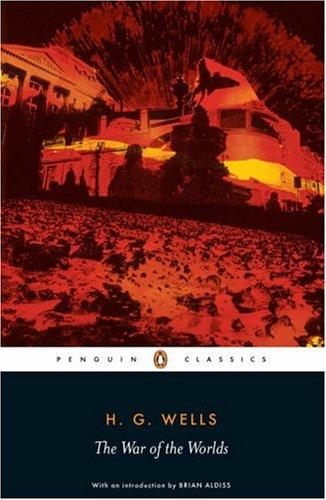
Deep Overview
The novel opens with a calm, almost scientific observation of the red planet and a sobering claim: the human race has been watched by minds far older and colder than its own. Soon afterwards, flashes are seen on Mars, and a cylinder lands on Horsell Common near Woking. The narrator is a writer with a philosophical bent. He joins the curious crowd, and the first lesson of the book follows quickly. Humans meet something unprecedented with ordinary manners and a white flag, and are burned down by a heat-ray.
The first part, The Coming of the Martians, follows the narrator's attempt to get his wife to safety and his gradual realisation that the military cannot stop the invaders. The Martians climb out of their cylinders and assemble tall, striding fighting-machines, the tripods. They use the heat-ray and a poisonous black smoke, and the English landscape of villas, railway lines and the Thames valley is wrecked within days. Wells uses short, concrete scenes, such as a train packed with fleeing passengers or a warship that fights to cover an evacuation, to show how quickly social order thins out.
The second part, The Earth under the Martians, is quieter and stranger. The narrator is trapped in a ruined house with a curate whose religious certainty collapses into hysteria. He later meets an artilleryman who dreams of rebuilding humanity underground and cannot match the dream with any real discipline. Both men are studies in the failure of inherited ideas. The narrator crosses a devastated London and sees the Martians' red weed spreading across the land, and the book then arrives at an ending that depends on microbes rather than human heroism.
What Wells wants to demonstrate is not simply that humanity is vulnerable. He sets up a chain of reversals. Those who conquered and classified other peoples are classified and harvested themselves; confidence in progress is exposed as a habit rather than a law of nature; and intelligence without feeling is shown to be as dangerous in Mars as it might be in Britain. The narrator's own reactions are also an argument. He is cowardly at times, curious at others, and often most aware of his insignificance when he is safest. The novel's lasting power comes from this combination of spectacle and moral unease, and from a narrator who is a witness more than a hero.
Key Themes
Imperial reversal is the book's sharpest idea: Britain, the world's dominant empire, is made to experience conquest from the receiving end. Closely tied to it is Darwinian struggle, with intelligence, technology and adaptation treated as the real determinants of survival, not moral worth. The novel also examines the fragility of civilisation, showing how quickly trade, transport, policing and neighbourliness break down under panic. Religion and philosophy are tested through the curate and the narrator's own reflections. A further theme is the limits of scientific and military confidence, since expertise on Earth offers no immediate answer to an unknown threat. Finally, the book sets human self-importance against cosmic indifference, and its ending suggests that humanity's fate may depend on forces it neither controls nor fully understands.
Historical Context
The novel belongs to the 1890s, when Britain was at the height of its empire and anxious about its own decline. Invasion stories such as George Chesney's The Battle of Dorking, from 1871, had already made fictional attacks on Britain a popular genre; Wells moved the attacker off the continent altogether. Astronomy shaped the idea of Mars as a possible home for an older civilisation, and the speculation about canals on its surface was current in the period. Evolutionary science, which Wells studied seriously as a student of the biologist T. H. Huxley, supplied his sense that species and civilisations could be displaced. Wells also later said that the novel was partly inspired by the destruction of the Aboriginal population of Tasmania under British colonisation, and that connection is a major part of modern readings of the book. The setting is real: Wells wrote much of the novel while living in Woking, and the local geography is carefully used. The story has also had a long afterlife, including Orson Welles's 1938 radio dramatisation in the United States, which is remembered for causing panic, although how widespread that panic really was is debated by later researchers.
Intended Audience
This edition suits readers who want a classic of science fiction and are curious about where modern alien-invasion stories come from. It will appeal to students of Victorian literature, history of science and empire, and to anyone who knows the story only from film, radio or music and wants the original. Readers who appreciate short novels with a clear central premise should find it accessible. It may be less satisfying for readers who expect modern character development, detailed world-building of the Martians, or an action-driven plot with a conventionally heroic protagonist, since Wells keeps his narrator ordinary and often passive. Readers sensitive to Victorian attitudes toward class, gender and race should also expect period assumptions to appear at times.
Reading Difficulty
The novel is short and moves briskly, and its sentences are mostly clear. The main obstacles are period features: Victorian vocabulary, references to contemporary English geography and technology, and some long reflective paragraphs. The narration is retrospective and first-person, so the pace alternates between direct action and meditation. There is little conceptual complexity beyond the allegorical and scientific ideas behind the Martians. The Penguin Classics paperback is a standard-size mass-market-style classic with editorial apparatus, which helps readers who want explanations of dated references. Readers who find notes distracting can read the text first and consult the introduction and notes afterwards, particularly since an introduction may discuss events from the ending.
Helpful Background Knowledge
No specialist knowledge is required. A little context will deepen the reading, though. A rough picture of late-Victorian Britain and its empire clarifies the novel's irony. A basic understanding of Darwinian evolution helps with the Martians' appearance and the book's attitude to survival. It is also useful to know that Mars was widely imagined as inhabitable in the 1890s, and that Wells was writing in the tradition of invasion literature. Readers who know Surrey, Woking, Richmond or central London will recognise many of the places, but a map is enough for everyone else. It is also worth knowing that the story has been adapted so often that its plot points may feel familiar, even though the original is more reflective than most adaptations.
Why Read This Book?
Choose this edition if you want the foundational text rather than a descendant of it. Among science fiction books, few have had such a visible influence on film, television, radio, comics and music, and the novel is often cited among books made into movies that readers feel compelled to compare with the source. The reward of going back to the book is that Wells's version is more thoughtful and bleaker than many adaptations. It makes the invasion a test of ideas about power, evolution and faith, and it ends on a note of uneasy relief rather than triumph. This Penguin Classics edition is also useful for readers who want a scholarly introduction and notes alongside the text, supplied by the novelist and critic Brian Aldiss, the editor Patrick Parrinder and the annotator Andy Sawyer.
Reader Takeaways
A careful reader can come away with a clearer sense of how a scientific romance of the 1890s used a fantastic event to examine real social attitudes. You may reconsider the assumption that invasion stories are about military heroes, since the narrator mostly survives by hiding, observing and travelling. You may notice how Wells links colonial violence at home and abroad, and how he builds suspense from small domestic details. You may also see how the novel's structure, with its collapse in the first half and its reflective hush in the second, shapes the final emotional effect. Finally, comparing the book with later adaptations gives practice in recognising what changes when a story's setting, message and tone are translated into other media.
Strengths
The novel's greatest strength is concentration. Wells sustains a single, vivid premise in a relatively short space and gives it moral and intellectual weight. Its use of a real English landscape makes the fantastic events feel immediate, and its narrator, though not heroic, is convincingly human. The structure moves effectively from shock to aftermath, and the secondary figures of the curate and the artilleryman allow Wells to examine competing responses to catastrophe. The book is also unusually rich as a historical document: it records late-Victorian fears about empire, science and decline. The Penguin Classics apparatus adds scholarly framing and explanatory notes.
Limitations and Cautions
The story is tied to its period, and some attitudes to class, gender and race, along with some scientific ideas about Mars and biology, are dated. The Martians are described mainly through the human narrator's revulsion, so readers hoping for a developed alien perspective will not find one. Female characters have limited roles, and the narrator's wife largely disappears from the action. The reading of the novel as a critique of imperialism is widely discussed but remains an interpretation, and critics weigh Wells's own later political views and the novel's anxieties differently. Page counts and exact publication details for this edition vary between catalogues, so readers needing a citation should check the physical copy. The introduction may reveal the ending, so first-time readers may prefer to read it afterwards.
Important Concepts, People, and Places
H. G. Wells (1866–1946): the English writer whose early scientific romances, including The Time Machine, established him as a leading figure in the genre; he wrote this novel while living in Woking. The unnamed narrator: a writer and amateur philosopher who witnesses the invasion and supplies the book's reflective voice. The Martians: the invaders, portrayed as coldly intelligent beings who treat humans as a resource and bring Darwinian competition to Earth. Tripods (fighting-machines), the heat-ray and the black smoke: the technologies through which Wells dramatises overwhelming force. Horsell Common and Woking: the landing site and the real Surrey setting that anchors the story. London: the capital whose evacuation and ruin form the book's central image of social collapse. The curate and the artilleryman: two men the narrator meets in the second half, representing religious and utopian responses to catastrophe. Scientific romance: the period genre label for Wells's speculative fiction. Invasion literature: the earlier genre of future-war stories the novel reworks. Tasmania: the colonial atrocity Wells associated with the novel's moral idea. Brian Aldiss, Patrick Parrinder and Andy Sawyer: the introduction writer, editor and annotator of this edition. Orson Welles's 1938 radio drama: the best-known adaptation, important to the book's cultural afterlife.
Questions the Book Explores
What does a civilisation owe the people it overpowers, and how does it feel to be treated in the same way? Is intelligence without sympathy a form of progress or a danger? How reliable are scientific authority, military power and religious comfort when something truly unfamiliar appears? What does a single, limited eyewitness actually understand about a global catastrophe? And does survival by accident, rather than by merit or effort, change what humans should think about their place in nature?
Reading Group Guide
A useful way to structure a discussion is by the book's two-part form. Start with the first half's speed and shock, then compare it with the quieter second half. Ask members to bring one scene they found most vivid, and compare how the narrator's perspective shapes it. If the group has seen any adaptation, such as the 2005 film or the 1938 radio play, compare what was kept and what changed, especially the ending and the moral tone. It also helps to agree beforehand whether the introduction and notes will be read before or after the novel, since they may discuss the ending. Groups interested in history may want to compare the Victorian setting with the attitudes to empire discussed in the editorial material.
Discussion Questions
1. Why might Wells have chosen an ordinary, unnamed narrator rather than a soldier or scientist?
2. How does the novel's opening reflection on Mars shape the way you read the invasion?
3. In what ways does the book invite British readers to see their own empire differently?
4. What do the curate and the artilleryman reveal about different responses to disaster?
5. How does the shift in tone between the two parts affect your sense of the story?
6. Is the ending hopeful, ironic, or both?
7. Which details of the Surrey and London settings make the events feel believable?
8. How do the Martians compare with the humans in their treatment of other living things?
9. What changes when the story is adapted for film, radio or music, and what is lost?
10. Which aspects of the novel feel most dated, and which feel surprisingly current?
Sources and Verification
The edition details come from the publisher's own listings (Penguin Random House and Penguin Australia) and a library-style catalogue record, and they confirm the title, author, ISBN-13 and the contributors to this edition. Background on the novel's composition, serialisation and 1898 book publication comes from reference sources and a local heritage society; information about Wells's life comes from an encyclopaedia entry; and discussion of the 1938 radio broadcast and of the Tasmanian connection comes from reference and journalistic sources. Sources disagree on the exact 2005 release date and slightly on page count, so no precise publication date is given and the page count follows the publisher. Interpretive statements are presented as readings of the book, not as settled facts. The profile is original and does not reproduce the book's text.