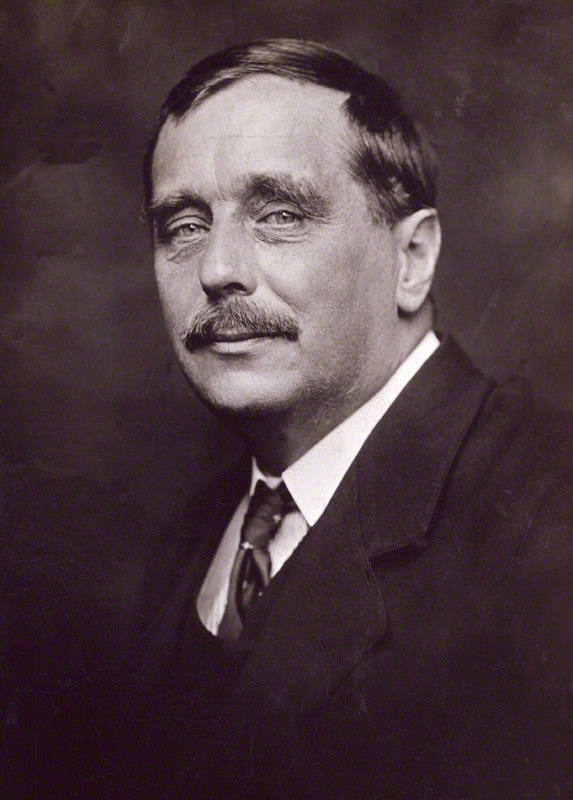
Herbert George Wells was born in Bromley, Kent, in 1866, into a family of shopkeepers who never had much money. He worked as a draper's apprentice and a chemist's assistant before a scholarship took him to London to study biology under T. H. Huxley. Teaching came first, then writing. He died in London in 1946.
He is remembered above all for the scientific romances of his twenties and thirties. The Time Machine (1895) was his first novel. The Island of Doctor Moreau, The Invisible Man and The War of the Worlds followed within three years. The pattern is consistent: one startling scientific idea dropped into an ordinary English setting, then a close look at what frightened or greedy people do with it. He was just as productive outside the genre. Kipps and The History of Mr Polly are comic novels about lower-middle-class life, drawn partly from his own years behind a shop counter. The Outline of History (1920) tried to tell the whole human story for general readers. A committed socialist, he joined the Fabian Society and twice stood for Parliament as a Labour candidate for London University.
He was nominated for the Nobel Prize in Literature four times but never won. The 1933 Universal film of The Invisible Man, directed by James Whale and starring Claude Rains, is one of many adaptations of his work. A crater on the Moon carries his name.
Start with The Invisible Man. It is short and quick, and Griffin, a scientist who makes himself invisible, slides from experiment into violence. The Penguin Classics edition, edited by Patrick Parrinder with an introduction by Christopher Priest and notes by Andy Sawyer, adds a biographical essay and a reading list. If it hooks you, The Time Machine and The War of the Worlds come next. The History of Mr Polly shows his gentler side.