
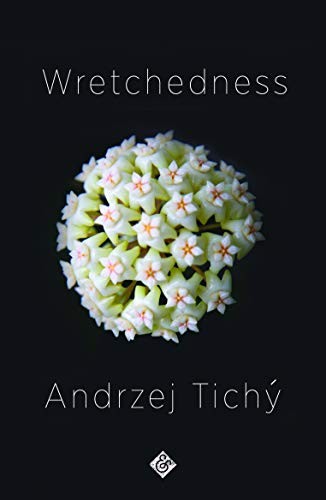
Wretchedness
In Wretchedness, Andrzej Tichý follows a classical cellist whose brief encounter with a homeless addict by a Malmö canal pulls him back into the life he left behind. That life was a 1990s youth on the city's multi-ethnic margins, full of fights, drugs, raves and friends who never got out. Nichola Smalley translated the novel from Swedish. It unfolds as one restless act of remembering, in which past and present, and the narrator's voice and the voices of others, keep running into each other. The book matters because it pairs this daring form with a hard question: what does someone who escaped owe to those who stayed, and what does their fate say about a country proud of its fairness? The novel was shortlisted for the August Prize and longlisted for the International Booker. It stands among contemporary world literature books that reward readers willing to follow rhythm until meaning comes into focus.
Where to buy or borrow
We don’t list any stores or libraries for this book yet.
Are you selling this book? Bookstores, publishers, authors and libraries can be listed here for free. Request a listing
About this book
Deep Overview
Tichý's central project is to make the reader experience consciousness as it actually operates: not in clean sentences with clear subjects and objects, but as a flood of images, half-heard phrases, overlapping memories, and sensory details that intrude on one another. The Guardian review compares the effect to a "blurry tornado of voices and timelines," and The White Review notes that the novel "soars with no middle flight." The text deliberately withholds the structural scaffolding a conventional novel provides—chapter breaks, scene transitions, reliable point of view—so that the reader must actively construct coherence, much as a listener reconstructs a melody from overlapping harmonics.
Beneath this formal experiment lies a sustained political argument. The characters are overwhelmingly children of immigrants from across Europe—Bosnian, Polish, Czech, North African—who grew up in Swedish suburbs that were simultaneously celebrated in policy as integration successes and maligned in local press as "a human rubbish dump." The narrator's father, in a recalled line, tells his son they have come to "PARADISE," only to read in the paper that it is a "HUMAN RUBBISH DUMP." Tichý is interrogating the gap between Sweden's self-image as a social-democratic utopia and the lived reality of second- and third-generation immigrants in the estates. The author himself, born in Prague to a Czech father and Polish mother and raised in Malmö from the age of three, occupies a position inside this gap, and the novel carries the weight of that personal stake.
Music operates on two levels. On the surface, the cellist and his colleagues discuss microtonal composition, open C tuning, and the structures of Scelsi's and Riley's works, and these conversations provide the novel's present-tense frame. On a deeper level, music is the organizing principle of the text itself: repetition, timbre, density, and the slow emergence of a single sustained note from a mass of sound. The White Review draws a direct analogy between Scelsi's compositional method—shifting focus from harmony and structure to timbre and density—and Tichý's narrative method, which shifts focus from plot and character to the grain and pressure of language.
The novel's conclusion enacts a perspective shift that recontextualizes the entire text. The White Review describes it as a "clever and forceful sleight of hand" that splits the narrative plane, suggesting two worlds separated by an impasse. The Literary Review calls it a "striking perspective shift" that invites multiple readings. This ending transforms the cellist's story from a survivor's account into something more ambiguous: a question about whether escape from wretchedness is genuine liberation or a form of erasure, and whether the artist's distance from the suffering he witnessed constitutes empathy or abandonment.
Simone Weil's epigraph—"Contradiction alone is the real world"—frames the whole project. Tichý is not offering a unified moral lesson or a clear social diagnosis. He is presenting the contradictions of Swedish society, of the narrator's own complicity and guilt, of the relationship between art and suffering, and asking the reader to hold them all at once without resolving them.
Key Themes
Survivor's guilt and the ethics of escape: The cellist's relationship to his past is not simple gratitude or nostalgia. He recognizes that his musical talent allowed him to leave the estate, but the cost was that his friends did not leave. The novel interrogates whether artistic success purchased by social mobility is a form of privilege that requires accountability, and whether the audience who consumes the artist's work is complicit in the silence around the people he left behind.
Sweden's myth of paradise: The book repeatedly invokes Sweden's international reputation as a social-democratic success and then undercuts it with the specific experience of immigrant families in the estates. The father's "PARADISE" / "HUMAN RUBBISH DUMP" line is the thematic hinge, and the novel sustains the tension without resolving it.
Music as structure and as escape: Music is both the cellist's salvation and the novel's formal principle. Scelsi's sustained-note compositions, Riley's repetition, Cage's chance operations—all serve as models for how the text organizes itself. Music is also the one constant that connects the narrator's two lives, the estate and the concert hall.
Consciousness and the failure of narrative: The long paragraphs, the absence of quotation marks, the merging of voices, the unreliable memory—all enact the idea that human thought does not come in clean sentences. The novel is as much about the limits of storytelling as it is about any particular story.
Generational and cultural identity: The characters are shaped by being the children of immigrants in a country that does not fully claim them. Their identity is assembled from code-switching, slang, music, and a shared sense of not belonging to any single nation. "A conventional pride of place was impossible for us, let alone national pride" is a line that summarizes this theme.
Historical Context
The literary context is also important. The Guardian reviewer draws a parallel to the Trainspotting era of British vernacular fiction in the 1990s, and several reviewers note the influence of Thomas Bernhard's long, nested sentences and his preoccupation with music and social marginality. The stream-of-consciousness mode connects the novel to a longer tradition—Joyce, Faulkner, Proust—that Tichý engages but transforms by removing the conventional markers (paragraphs, dialogue tags, scene breaks) that make those works navigable. The White Review positions Tichý's method as closer to Scelsi's music than to any single literary predecessor, and the comparison to Bernhard is the one most often drawn in critical discussion.
The translation context matters as well. Tichý's first four novels appeared in Swedish between 2005 and 2015, and Wretchedness (2016) was his first to be translated into English, a gap of fifteen years that places the book squarely within the broader movement of discovering and promoting translated fiction in the Anglophone world. Nichola Smalley's translation, which won the Oxford-Weidenfeld Prize, is a significant contribution to the visibility of Swedish and Nordic writing in English. The 2021 International Booker Prize longlisting further situated the novel within the ongoing effort to expand the boundaries of what the Anglophone literary market reads.
The political context of publication (2020 in English, 2016 in Swedish) overlaps with Europe's migrant crisis, which made the question of Sweden's relationship to its immigrant populations newly urgent in public debate. Tichý's novel, though set in the 1990s, speaks directly to that moment: the Guardian review notes that the book's project is to "disrupt perceptions of the country as a liberal utopia," and the author himself told The Guardian that "From the outside, Sweden was this paradise. But it was never actually true."
Intended Audience
It will also suit readers who want to see Scandinavian society from the edges rather than through its official image. People interested in migration, in the children of immigrant families growing up in European cities, or in class and social mobility will find these subjects shown from the inside, through lived detail rather than argument. Musicians and people who listen to experimental or minimalist music may find an extra layer here, because the book's handling of repetition and texture works much like listening does.
Readers who want a clear storyline, characters who stay distinct from page to page, or an ending that settles things should think carefully first. The novel gives few signals about who is speaking, where a scene takes place, or whether a passage is memory or the present, and some readers find this exhausting rather than absorbing. Some reader responses describe losing the thread, skimming sections, or finding the style hard to bear. That reaction is a real possibility and not a misreading. Reading in short sittings, or rereading passages, can help readers who are unsure but curious.
The book depicts drug use, physical violence, early death and social exclusion throughout, and its narrator sometimes voices hostile, uncomfortable thoughts. None of this is softened. Readers who are sensitive to these subjects should go in prepared, even though the tone is plain and unsentimental, not sensational.
Reading Difficulty
The vocabulary is a mix of registers: the cellist's present-day discussions of microtonal composition and musical terminology sit alongside the raw, slang-heavy speech of his estate youth, including profanity, multilingual code-switching, and references to 1990s music, football, and street culture. The White Review notes that the text shifts between "discussion of avant-garde art and description of physical combat" with almost invisible transitions, and The Literary Review describes the effect as a "break-neck jump cut" between past and present. Readers who are not fluent in either the musical vocabulary or the street vernacular will find passages slower to parse.
The conceptual difficulty is real but not academic. The novel does not require specialized knowledge of music theory, Scandinavian politics, or postmodern literary criticism to be accessible. However, familiarity with the referenced composers (Scelsi, Riley, Cage) and a general sense of the stream-of-consciousness tradition help. The primary prerequisite is patience: the text does not hand the reader a map, and the pattern of blending and shifting becomes more familiar only after the first full paragraph or two.
At 165 pages, the novel is physically short, but the density of language means that the reading time can feel longer than the page count suggests. Several reviewers describe the experience as one of sustained concentration, with the reward arriving not in a plot climax but in a shift of perception at the novel's abrupt ending.
Helpful Background Knowledge
A passing familiarity with the avant-garde composers named in the text—Giacinto Scelsi, Terry Riley, and John Cage—will help the reader follow the cellist's present-day conversations and understand the musical metaphor that structures the novel. The White Review reviewer spent time looking up Scelsi's work after reading the book and notes that his compositions, particularly the sustained-note pieces, are a close analogy to Tichý's method. Listening to a short Scelsi or Riley piece before reading can prime the ear for the novel's rhythmic logic.
Readers who have experienced the long-sentence, stream-of-consciousness mode in Thomas Bernhard, James Joyce, or William Faulkner may find the form less alien. The Guardian reviewer draws an explicit parallel to the *Trainspotting* era of 1990s British vernacular fiction, and that comparison may help position the novel for readers who know that tradition.
Familiarity with 1990s European youth culture—drum and bass, rave scenes, and music by DJ Krush, Snoop Dogg, Slipknot, and other artists—may help readers recognize the cultural references. In *The Literary Review*, Forrest Roth notes that the novel references European musical acts that will likely be obscure to American readers, alongside better-known albums from the 1980s and 1990s. These references provide musical and cultural context, but readers do not need to recognize every artist to follow the novel.
Why Read This Book?
The formal experiment is the book's other major draw. If you want a novel that reads like a piece of music—where repetition, timbre, and density matter more than plot—Tichý delivers that with a consistency that few contemporary writers match. The structure is not a gimmick; it is the meaning. The long paragraphs, the blending of voices, the absence of quotation marks all enact the novel's argument that consciousness does not come in clean units. For readers of literary fiction who feel that the contemporary novel has settled into a comfortable, predictable form, Wretchedness is a reminder that the medium can still surprise.
Nichola Smalley's translation is a reason in itself. Winning the Oxford-Weidenfeld Prize, the translation preserves the slang, the code-switching, the rhythmic density of the Swedish original. Reading this novel in English is an act of cross-linguistic encounter that enriches both the book and the reader's sense of what contemporary European fiction sounds like.
Finally, the book is short. At 165 pages, it is a committed but manageable reading. The density means it is not a quick read, but it is not a novel that will consume months of reading time either. For readers building a reading list of challenging but finite works, Wretchedness fits well.
Reader Takeaways
The novel also prompts reflection on the ethics of artistic success that is purchased by social mobility. The cellist's talent is real, and his music is genuinely good, but the novel never lets him (or the reader) forget that his escape depended on a set of circumstances his friends did not share. The question of whether art can or should atone for the suffering it emerges from is raised without being answered.
Readers who are attentive to form will notice how the novel's structure enacts its themes: the long paragraphs are not just a stylistic choice but a representation of how memory actually works—continuous, overlapping, resistant to the clean cuts that conventional narrative imposes. The ending's perspective shift forces a reread and a re-evaluation of everything that came before, and that experience of the text splitting open under scrutiny is itself a takeaway about how meaning is constructed and how easily it can be destabilized.
For readers of translated fiction, the book is a concrete example of why translation matters: the novel's power depends on the specific rhythm of its sentences, the way slang and musical terminology collide, and the fact that the voice is not a generic "European" voice but a specific one, rooted in a particular Swedish suburb, a particular generation, and a particular multilingual family. Smalley's translation preserves that specificity, and the reading experience rewards attention to how the English version handles code-switching, profanity, and the music of the sentences.
Strengths
The polyphonic treatment of voices is handled with unusual skill. The White Review praises the "virtuosic layering" of voices and the way the text refuses a single vantage point from which to judge the characters. The cellist is not a reliable narrator, and the novel does not ask the reader to resolve the contradictions between his sympathy for his friends and his moments of anger and distance. This refusal of a clean moral position is what makes the social commentary more credible than a more didactic approach would be.
Nichola Smalley's translation is a significant achievement in its own right. The Oxford-Weidenfeld Prize recognizes that the translation preserves the slang, the rhythm, the code-switching, and the specific texture of the Swedish original. The Guardian's second review describes the translated text as "bloodily dark poetry," and multiple reviewers note that the translation captures both the gritty reality and the lyrical moments without flattening either.
The novel's scope is both broad and precise. It covers a specific place (Malmö and its suburbs), a specific time (the mid-1990s into the present), and a specific community (children of immigrants in Swedish housing estates), but the themes—dispossession, the ethics of escape, the relationship between art and suffering, the failure of the nation-state to deliver on its promises—are universal enough to resonate beyond that context. The Guardian review notes that the novel will take readers "to places you have never been," and that specificity is what gives the universal themes their weight.
The book's brevity is an asset. At 165 pages, it is dense enough to reward close reading and short enough to be approachable. The structure, which might be exhausting over 400 pages, works at this length because the reader can hold the whole arc in mind without losing the thread entirely.
Limitations and Cautions
The novel's political and cultural context includes Swedish housing estates, immigrant experiences, and European music scenes. *The Literary Review* notes that some of the European musical acts referenced in the novel may be obscure to American readers. Readers unfamiliar with these references may miss some cultural associations, but the reviews do not establish that prior knowledge is necessary to understand the novel.
The novel depicts drug use, violence, and marginalization. *The White Review* discusses scenes involving drug use and physical violence, as well as a moment in which the narrator suggests exterminating the addict father of a friend's children. The review emphasizes the way the novel layers different voices and tones, complicating the question of where judgment lies. These elements may make the reading experience uncomfortable for some readers.
The ending's perspective shift is another point of potential ambiguity. *The Literary Review* describes what appears to be a striking shift in narrative perspective and acknowledges that other readers may interpret it differently. *The White Review* also examines the implications of the ending's change in perspective. Amy, writing on *warm days will never cease*, describes the plot as “weird” and says she struggled to identify its thematic argument. These differing responses illustrate how the novel's experimental form can invite contrasting interpretations.
*Wretchedness* was originally published in Swedish in 2016 and appeared in English translation in 2020. Its depictions of immigration, marginalization, and life in Swedish housing estates provide grounds for reading it in relation to contemporary European social and political concerns. However, describing the novel as a direct or indirect response to the 2015 European refugee crisis is an interpretation rather than a straightforward bibliographical fact. Readers seeking an explicit treatment of that specific crisis should distinguish that expectation from the broader social concerns explored in the novel.
Important Concepts, People, and Places
Giacinto Scelsi: The Italian composer whose work the cellist is preparing to perform. Scelsi's avant-garde compositions, particularly his sustained-note pieces, serve as the formal and thematic model for the novel's structure. The White Review draws an explicit analogy between Scelsi's shift of focus from harmony to timbre and Tichý's shift from plot to the grain of language.
Simone Weil: The French philosopher and mystic whose epigraph—"Contradiction alone is the real world"—frames the novel. Weil's thought on attention, suffering, and the nature of the real is a backdrop for the narrator's own meditation on the relationship between art, suffering, and the lives of others.
And Other Stories: The independent UK publisher that brought Wretchedness to English-language readers in 2020. The press is known for its focus on literary fiction, often translated, and its subscription model, which includes print and ebook titles. The publisher's commitment to translated fiction is central to the book's accessibility in English.
Nichola Smalley: The translator whose English version of Eländet won the Oxford-Weidenfeld Prize for book-length literary translation. Her work preserves the slang, rhythm, and code-switching of the Swedish original and is integral to the novel's effect in English.
International Booker Prize: The 2021 longlisting of Wretchedness brought the novel to a wider Anglophone audience and situated it within the broader conversation about translated fiction in the literary prizes. The longlisting is a recognition of the book's significance as a work of world literature.
Thomas Bernhard: The Austrian novelist whose long, nested sentences and preoccupation with music and social marginality have drawn comparisons to Tichý's work. The White Review draws a direct comparison, noting that both writers use musical form to make sense of their relationship to conventional plot, but that Tichý "is more likely to affirm by affirming" where Bernhard "affirms in the negative."
The housing estates (bostadsområden): The physical and social spaces where the novel's characters grew up. These postwar social-housing developments in the suburbs of Swedish cities became concentrated sites of immigrant communities and, by the 1990s, were increasingly framed in local and national media as problem zones. The estates are the novel's primary setting and the site of its central social argument.
Questions the Book Explores
Can a society that markets itself as a social-democratic paradise coexist with the experience of its own residents who feel like second-class citizens? The novel holds Sweden's self-image and the lived reality in the estates in sustained tension, without resolving the contradiction.
How does consciousness actually work? The novel's form is an argument that thought does not come in clean sentences, that memory is not linear, that the self is not a single stable voice. The long paragraphs, the blending of speakers, the intrusion of music into memory—all are enactments of this question.
What is the relationship between art and suffering? The cellist's music saves him, but the novel asks whether the art that is made from suffering is a form of exploitation, a form of atonement, or something else entirely. The reader's position as consumer of the artist's work is implicitly questioned.
Is there a way to love or empathize with a person who has made choices you would not make, and to also feel anger, distance, or judgment? The narrator's admission that he "also wants to smash their faces in" alongside his sympathy is one of the novel's most honest moments, and the text does not resolve the contradiction.
What does it mean to belong to a country that your parents chose for you, when the country's media calls the neighborhood you grew up in "a human rubbish dump"? The novel's characters navigate a space between legal citizenship and experiential exclusion that does not map neatly onto any single political category.
Can a novel be a piece of music? Tichý's answer is yes, and the novel enacts the argument: repetition, timbre, density, and the slow emergence of a single sustained note from a mass of sound are the principles by which the text is organized, and the reader's experience of the novel is meant to resemble the experience of listening to a complex composition.
Reading Group Guide
A productive discussion starting point is the question of form. Ask the group: What does the absence of quotation marks and paragraph breaks do to your experience of the characters? Does the blending of voices create a sense of community or of confusion? Does the structure feel like it enacts the novel's themes, or does it get in the way? Readers may have quite different responses, and those differences can be part of the discussion.
The novel's political content is best discussed by establishing what the text actually says rather than what readers assume it should say. The Guardian review notes that the book's project is to “disrupt perceptions of the country as a liberal utopia.” Ask: What specific moments in the text challenge or confirm your own assumptions about Sweden, immigration, and social welfare? Where does the novel complicate a simple narrative of victimhood or failure?
The music references are another source for discussion. If several group members have not encountered Scelsi, Riley, or Cage, listening to a short piece by one of these composers before the meeting is an optional way to explore the musical context. In *The White Review*, Klaces draws an analogy between Scelsi's compositional method and Tichý's narrative method. The group can use that comparison to discuss the novel's rhythms, repetitions, and shifts in tone without assuming that every reader needs musical knowledge to appreciate it.
The ending offers a significant point for discussion. Allow time for the group to consider the perspective shift before drawing conclusions. *The Literary Review* describes what appears to be a striking change in narrative perspective and acknowledges that other readers may interpret it differently. Rather than treating the ending as a puzzle with a single solution, ask what different interpretations explain about the novel as a whole.
Finally, discuss the novel's depictions of drug use, violence, and marginalization. If group members found these passages difficult, acknowledge their responses without trying to justify or minimize them. Amy's review on *warm days will never cease* describes a strongly negative reading experience, particularly because of the novel's form, and says the reviewer struggled to identify its thematic argument. That response is worth considering alongside more favourable readings. Readers do not need to feel comfortable with everything the novel depicts to discuss its effects.
Discussion Questions
The narrator says at one point that he "also wants to smash their faces in" alongside his sympathy for the people in his past. How does the novel handle that contradiction? Does it resolve it, sustain it, or make it worse? Does the reader's own response to the narrator's anger change depending on how much sympathy they feel for the characters in the estate?
The novel's form—long paragraphs, no quotation marks, blended voices—has been compared to Thomas Bernhard and to the stream-of-consciousness mode of Joyce and Faulkner. In what ways does Tichý's approach differ from those predecessors? Does the form serve the content, or does it sometimes obscure it?
The characters in the novel are overwhelmingly children of immigrants from across Europe. The novel does not take a specific political position on immigration policy. What is the effect of a novel that depicts the experience of marginalization without arguing for a particular solution? Is that a strength or a limitation?
The ending's perspective shift recontextualizes the entire novel. How does your understanding of the cellist change after the final pages? Does the shift make you feel the novel is about survivor's guilt, about the unreliability of memory, about the impossibility of knowing another person's experience, or about something else?
The novel references a wide range of music, from Scelsi and Cage to Snoop Dogg and Slipknot. How does the musical soundtrack function in the text? Is it a window into the characters' inner lives, a structural device, a cultural marker, or all three?
The Guardian review compares the novel to the Trainspotting era of British vernacular fiction. In what ways does Wretchedness echo or depart from that tradition? Does Tichý share Welsh's gallows humor, or is his tone different? How does the Swedish context change the effect?
The novel's epigraph is from Simone Weil: "Contradiction alone is the real world." How does that line shape your reading of the novel? Where in the text do you see contradictions held together without resolution? Where, if anywhere, does the novel seem to collapse a contradiction it should have sustained?
The translation by Nichola Smalley won the Oxford-Weidenfeld Prize. What does the novel ask of a translator? Are there moments where the English version seems to lose something from the Swedish, or to gain something? How does the code-switching and slang in the translation shape your experience of the characters?
If you had to recommend one piece of music to listen to while reading this novel, what would it be, and why? What does that choice reveal about how you experienced the book's relationship between music and narrative?
Sources and Verification
The page-count discrepancy is retained rather than silently resolved: World Literature Today lists 165 pages, while And Other Stories lists 176. The publisher's bibliographic record supplies the paperback ISBN (9781911508762), ebook ISBN (9781911508779), and exact publication date (2 June 2020). Claims about the novel's meaning, political implications, accessibility, and literary significance are treated as interpretations unless directly supported by an identified source.
Comments
No published comments yet.
Available editions
Paperback
First English edition
- Publisher
- And Other Stories
- Pages
- 165