
Related category
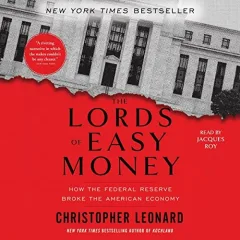
The Lords of Easy Money
How the Federal Reserve Broke the American Economy
Christopher Leonard examines the Federal Reserve’s transformation after the 2008 financial crisis, concentrating on years of near-zero interest rates and large-scale asset purchases known as quantitative easing. He argues that policies designed to stabilize markets and stimulate recovery also encouraged debt, elevated financial-asset prices, strengthened the position of major investors, and made the economy increasingly dependent on continued monetary support. The narrative is anchored by Thomas Hoenig, president of the Federal Reserve Bank of Kansas City, whose repeated dissents in 2010 expressed concern about financial instability and the long-term consequences of exceptionally easy money. Leonard also follows Jerome Powell from private equity into central banking, using corporate finance and industrial employment to connect monetary policy with activity outside Washington and Wall Street. The result is investigative economic journalism that presents central banking as a consequenti…