
Related category
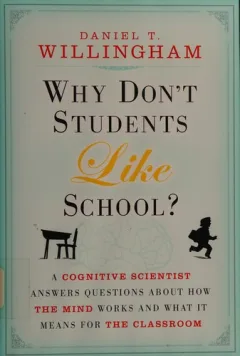
Why Don’t Students Like School?
A Cognitive Scientist Answers Questions About How the Mind Works and What It Means for the Classroom
Why Don’t Students Like School? explains classroom learning through cognitive psychology. Daniel T. Willingham begins with an apparent contradiction: people are curious, yet sustained thinking is slow, demanding, and often avoided. Students are most likely to engage when a problem is challenging enough to be satisfying but not so difficult that success seems remote. From that foundation, the book examines how prior knowledge supports reasoning and reading comprehension, why memory depends on what learners think about, why abstract ideas require concrete examples, and when practice helps. It also considers expertise, differences among learners, beliefs about intelligence, educational technology, and the mental demands placed on teachers. Rather than offering a single teaching method, Willingham presents cognitive principles and asks educators to adapt them to particular subjects and classrooms. The result is an accessible bridge between research on memory and thought and the daily work…