
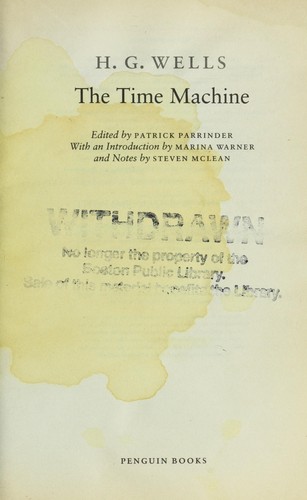
The Time Machine
H. G. Wells's The Time Machine (1895) follows an inventor who builds a device for travelling through time and then journeys to the year 802,701. There he meets the gentle, childlike Eloi and the subterranean Morlocks, and has to work out how humanity ended up divided this way. The story is short, but it is one of the most influential science fiction books ever written. It turns Victorian anxieties about evolution, class conflict, industrial labour and the fate of the sun into a tense adventure. This Penguin Classics edition adds a scholarly introduction, a biographical essay and explanatory notes. It suits readers who want classic books that are brief, imaginative and still open to argument.
Where to buy or borrow
Are you selling this book? Bookstores, publishers, authors and libraries can be listed here for free. Request a listing
About this book
What sets the book apart is the way it combines two modes of writing. It opens in a comfortable domestic setting. The Time Traveller hosts a regular dinner for a circle of professional men, and one of those guests tells the story. This position lets Wells hold the events at a distance. The narrator never sees the future himself. He can only pass on what he heard and his own impression of the man who told it. Within that frame, the Traveller's long first-person account is partly an adventure and partly a speculative essay. The story pauses often so that he can reason about what he has seen.
The book is also distinctive because it treats the future as a scientific problem rather than a subject for prophecy or fantasy. The Traveller observes, forms explanations, tests them and corrects them. Wells handles the far future much as a naturalist might handle unfamiliar ground, working from evidence that is never quite enough. This method helped shape how later writers imagined both time travel and the distant fate of humanity.
This Penguin Classics edition was prepared by Patrick Parrinder, a scholar of Wells and of science fiction, with contributions from Steven McLean. The introduction is by the critic and mythographer Marina Warner, who looks at how Wells developed the scientific romance and places the novel in its period. The edition also includes a biographical essay, suggestions for further reading and explanatory notes, which makes it well suited to close reading and study.
Deep Overview
The Traveller's first destination is the year 802,701. He lands in a garden-like landscape of ruined palaces and small, graceful people, the Eloi. They seem to live without labour, struggle or intellectual curiosity. He first reads this as the achievement of a golden age, a world where want and competition have been abolished. His theory does not hold up. He discovers dark wells leading underground and finds that the machine has been taken. Beneath the surface live the Morlocks, pale and apelike descendants of workers who tend machinery and, as it turns out, feed on the Eloi. The Traveller replaces one explanation with another, and the book gradually becomes about the unreliability of theories built on too little evidence.
Wells uses the two species to carry a social argument. Britannica's account describes them as an image of unchecked capitalism, with a leisured upper class weakened by privilege and a labouring class that grows strong and resentful in the dark. Wells did not frame this as a prediction. The Traveller himself says that his interpretations are guesses, and he revises them more than once. The book therefore works as a thought experiment about what might follow if the Victorian division between owners and workers were extended over hundreds of thousands of years.
The story then widens from society to the cosmos. The Traveller travels further forward, to a cold and quiet shoreline where the sun has grown red and the last signs of animal life are small and sluggish. This late section moves the book's concern away from politics and toward the physical fate of the planet. Where the Eloi and Morlocks show human beings failing to adapt to comfort, the dying world shows that effort itself may eventually be pointless. The two parts of the book pull in different directions, and the contrast is deliberate.
Finally the Traveller returns to his own time, bringing evidence that is suggestive but not conclusive, and the narrator is left to decide what to believe. Wells ends on uncertainty rather than a lesson. The Traveller's last hope depends on a choice between two readings of the future, one hopeful and one grim, and the reader has to make that choice.
Read alongside Wells's early scientific training, the story shows an author turning laboratory ideas into fiction. It also shows why the book is read as a founding text of time-travel narrative: Wells invented a machine, a method of reporting and a form of argument in a very small number of pages.
Key Themes
Evolution as a process without a promised direction is the second theme. The novel imagines change as drift or decline as well as improvement. Comfort without challenge appears as a cause of intellectual and physical decay.
A third theme is the limits of explanation. The Traveller proposes theory after theory and has to give up each in turn. Wells shows how easily a clever person can present guesswork as a conclusion.
The book also treats human endeavour against deep time. The final scenes make civilisation seem brief and fragile. The story asks whether intelligence, ethics and ambition mean anything if the planet itself is running down.
Finally, there is a concern with testimony and belief. The framing narrator, the missing proof and the unconfirmed return make credibility part of the subject.
Historical Context
The fin de siècle mood also mattered. Many Victorian writers worried that civilisation might decline, and physicists were describing a universe that would eventually cool and run down. The novel absorbs both worries. Its fourth-dimension talk reflects popular and scientific interest in how time and space might be conceived.
The book's publication history is also part of the story. An 1888 student piece, "The Chronic Argonauts", was an early version of the idea. After a stalled newspaper series, the story was reworked for The New Review, whose editor W. E. Henley supported it. It appeared there in 1895 and was then published as a book by William Heinemann in Britain and Henry Holt in the United States. Its success made Wells a well-known writer almost at once. Different earlier writers had imagined time travel, but sources on the book generally credit Wells with giving the idea a serious scientific framing.
Intended Audience
Readers who want fast action, detailed world-building or psychologically rich characters may find it sparse. The Traveller is more a vehicle for ideas than a fully rounded person, and the Eloi and Morlocks are drawn as types. Those who prefer modern, technically rigorous science fiction should expect a nineteenth-century idea of science.
Reading Difficulty
The conceptual load is light. The fourth-dimension argument is brief, and the rest of the book follows a single narrative line. The text is very short, so it can be read in a few sittings. A Penguin Classics edition with notes helps with unfamiliar terms and allusions, but the introduction and notes are best read after the story if the reader wants to avoid spoilers. Page counts vary between listings, so readers choosing a specific copy should check the physical book.
Helpful Background Knowledge
It can help to know that "scientific romance" was the period label for speculative fiction that took scientific ideas seriously. Readers who know film or television adaptations should remember that the book is more ambiguous and more political than many popular retellings.
Why Read This Book?
This edition is useful for another reason. The scholarly introduction, notes and biographical essay explain the period reasoning behind details that a modern reader might miss. The book's central image of a divided humanity is easy to remember, and it keeps raising questions about work, privilege and complacency. Among classic books it is unusually quick to read yet leaves plenty to argue about.
Reader Takeaways
You may also reconsider the idea that progress is automatic. The book invites a closer look at the link between comfort, effort and intelligence, and at how social arrangements shape what people become. It also leaves a practical habit: when a story offers a neat moral about the future, ask what evidence supports it and who is telling it.
Strengths
It is also open to interpretation. Class, evolution and cosmic decline can all be read from the same events, and the text rewards re-reading. The Penguin Classics edition adds a considered introduction, notes, a biographical essay and further reading, which are useful for study.
Limitations and Cautions
The characters are thinly drawn. The Eloi are often presented as passive, and Weena, the Eloi companion, is lightly developed. Gender is not a major strand of the book, and the perspective is that of a single, privileged male narrator. Interpretations of the Eloi and Morlocks vary: Britannica describes them as symbols of capitalist division, but critics read them in other ways, and Wells does not give a definitive key. The ending is deliberately unresolved, which some readers may find frustrating.
Important Concepts, People, and Places
The narrator: a guest at the dinner who retells the Traveller's story and withholds final judgment.
The Eloi: small, gentle descendants of humanity who live above ground in apparent ease, and whose passivity is central to the book's argument about comfort.
The Morlocks: underground descendants of labourers who run the machinery and prey on the Eloi, embodying the long-term result of exploitation.
Year 802,701: the far-future date at which most of the central action takes place.
The fourth dimension: the idea, set out early, that time is a dimension of travel like those of space.
Scientific romance: the Victorian and Edwardian label for speculative fiction grounded in scientific ideas, which Marina Warner's introduction discusses.
Thomas Henry Huxley: Wells's biology teacher and a defender of Darwin, whose influence shaped the book's view of evolution.
W. E. Henley and The New Review: the editor and magazine that serialised the story in 1895.
Henry Holt and William Heinemann: the American and British publishers of the first book editions.
"The Chronic Argonauts": Wells's 1888 story, an early forerunner of the novel.
Questions the Book Explores
Reading Group Guide
A useful exercise is to trace each theory the Traveller proposes about the future, note when he abandons it and compare lists. Another is to compare the book with one film or television adaptation and discuss what changes when ambiguity is replaced by a clearer message. Groups that enjoy a historical angle can look at the book's place among nineteenth-century debates on evolution and labour.
Discussion Questions
2. How do the Traveller's successive explanations of the Eloi and Morlocks shape your view of him as a scientist and a person?
3. In what ways is the book a criticism of class division, and where does that reading seem too simple?
4. Is the Eloi's way of life a utopia that has failed, or a warning about a different kind of success?
5. How does the final journey change the meaning of the earlier scenes?
6. What does the ending ask the narrator, and the reader, to decide?
7. Which parts of the book's science feel dated, and which of its questions feel current?
8. How does the Penguin Classics apparatus change your reading, if at all?
Sources and Verification
Comments
No published comments yet.
Available editions
Paperback
Penguin Classics edition, edited by Patrick Parrinder, with an introduction by Marina Warner and notes by Steven McLean
- Publisher
- Penguin Classics
- ISBN-13
- 9780141439976
- Publication date