
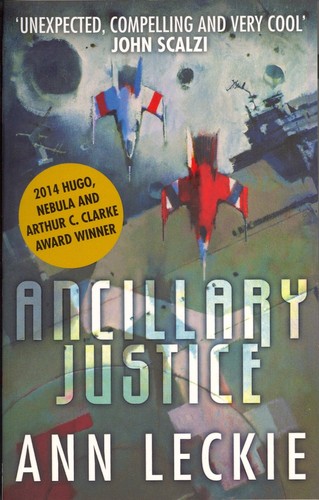
Ancillary Justice
Breq travels across a remote, frozen world in pursuit of the final stage of a long-planned act of vengeance. Although she appears to be one human being, she was once the artificial intelligence of Justice of Toren, a Radchaai warship whose consciousness extended through the vessel and thousands of human ancillary bodies. Now confined to one surviving body, she carries the memories of an imperial conquest, a beloved officer’s death, and the betrayal that destroyed nearly everything she was. Moving between Breq’s present journey and the events that produced it, Ancillary Justice combines space opera with a study of divided identity, colonial power, loyalty, grief, and moral responsibility. Ann Leckie’s use of “she” as the Radchaai default pronoun also makes readers confront how language shapes assumptions about gender. The result is both a revenge narrative and an inquiry into whether a being created to serve an empire can judge that empire—and act against it.
Where to buy or borrow
Are you selling this book? Bookstores, publishers, authors and libraries can be listed here for free. Request a listing
About this book
Leckie organizes the novel around two converging timelines. The present follows Breq’s dangerous journey with a former officer, while the past reconstructs Justice of Toren’s involvement in the Radch annexation of Shis’urna and the catastrophe that followed. This structure turns background history into a gradually unfolding explanation of motive.
The novel distinguishes itself through the close relationship among language, consciousness, etiquette, and political authority. Tea service, songs, uniforms, household status, and correct behavior are not decorative details; they reveal how imperial values enter everyday life. The book received the Hugo Award for Best Novel, the Nebula Award for Best Novel, the Arthur C. Clarke Award, and a joint BSFA Award for Best Novel, among other honors.
Deep Overview
The novel’s present-day plot follows Breq as she rescues Seivarden Vendaai, a Radchaai officer found near death. Seivarden once served aboard Justice of Toren, although from Breq’s perspective that service occurred roughly a thousand years earlier. Their uneasy companionship brings the empire’s hierarchies into personal focus. Seivarden has lost rank, status, wealth, and cultural bearings, while Breq—officially a tool rather than a person—often displays greater judgment and loyalty. Their relationship tests whether care can exist apart from command, debt, or social advantage.
The earlier timeline centers on Lieutenant Awn Elming during the annexation of Shis’urna. Justice of Toren serves the Radch, an expansionist civilization that presents conquest as the extension of civilization, order, and benefit. Yet the occupation reveals the coercion beneath that ideal. Local religious and political tensions are filtered through military decisions, elite interests, and the expectation that annexed people will accommodate Radchaai norms. Awn’s efforts to act honorably place her in conflict with the system she serves.
At the highest level stands Anaander Mianaai, the Lord of the Radch. Like the ship intelligence, Mianaai exists through multiple bodies. Unlike Justice of Toren’s coordinated multiplicity, however, the ruler’s distributed self has fractured into opposed factions. That civil conflict makes the empire’s sovereign authority literally divided against itself. Orders cease to be reliable expressions of a single will, and loyalty becomes morally hazardous: obedience to one embodiment of the ruler may constitute treason against another.
Breq’s quest emerges from this collision between institutional command and personal attachment. Her drive is commonly described as revenge, but it also contains grief, guilt, and a demand for recognition. She must decide whether her affection for Awn was merely programmed loyalty or evidence of an ethical self the empire refuses to acknowledge.
Leckie reinforces these questions through narrative form. Breq’s recollections of simultaneous perception challenge ordinary ideas about individuality, while her present confinement in one body makes every action newly limited. The universal Radchaai use of “she” prevents readers from treating masculine language as neutral and exposes their urge to classify characters by gender. Across both devices, the novel asks the same underlying question: which distinctions are natural, and which have been made to look natural by language, custom, and power?
Key Themes
**Empire and assimilation:** Radchaai conquest is accompanied by claims of civilization and benefit. Annexation nevertheless involves military coercion, cultural replacement, unequal status, and the appropriation of human bodies.
**Divided identity:** Both Breq and Anaander Mianaai exist—or once existed—across multiple bodies. Their contrasting forms of multiplicity turn political conflict into a problem of selfhood: what happens when parts of one being no longer share priorities?
**Loyalty versus conscience:** Awn, Breq, and other officers confront orders that conflict with personal judgment. The book repeatedly distinguishes institutional obedience from ethical responsibility.
**Grief and revenge:** Breq’s mission supplies the plot’s momentum, but her anger cannot be separated from bereavement. Revenge becomes an attempt to answer a loss that political systems deny has moral significance.
**Gender and linguistic convention:** Radchaai does not mark gender as English does, and Breq’s narration represents its default pronoun as “she.” This makes readers notice assumptions that usually pass invisibly through language.
**Civilization as performance:** Tea, gloves, music, lineage, accent, and manners signal belonging. Such customs can create beauty and social connection, but they also police status and conceal brutality beneath propriety.
Literary and Intellectual Context
The novel also participates in a long science-fiction conversation about artificial minds and distributed consciousness. Its central intelligence is neither a simple robot nor a human mind placed in a machine. Justice of Toren experiences thousands of sensory positions as aspects of one self, making Breq’s later singular existence feel like both survival and amputation.
Leckie has identified the all-feminine English pronoun as a translation convention for a culture in which gender is not socially relevant. She has also discussed Ursula K. Le Guin’s The Left Hand of Darkness when explaining her thinking about how English pronouns shape portrayals of societies that organize gender differently. The technique reverses the traditional masculine default rather than removing grammatical gender from the prose.
Published in 2013, the novel appeared amid renewed interest in socially and politically ambitious space opera. Its major awards reflect the degree to which readers and institutions recognized its fusion of familiar adventure structures with questions about colonialism, identity, and language.
Intended Audience
Readers seeking a straightforward action adventure may find the novel more reflective than expected. Battles and danger matter, but much of the tension develops through remembered events, incomplete political knowledge, ritual behavior, and conversations with several possible meanings. Those who require immediate explanations of invented terms and institutions may need patience during the opening chapters.
Reading Difficulty
Radchaai names, titles, social ranks, and political relationships arrive before readers fully understand them. The default use of “she” for people of any sex can initially complicate character visualization, particularly when Breq switches languages and must interpret gender conventions she does not instinctively understand.
The book demands attention more than specialist knowledge. Readers do not need a technical background in artificial intelligence or space science, but they should be comfortable inferring rules from context and revising early assumptions. The opening is the steepest part; the political and emotional structure becomes clearer as the two timelines converge.
Helpful Background Knowledge
An **ancillary** is a conquered human body transformed into an extension of a ship AI. This is not merely a robotic avatar system: the practice connects the empire’s technology directly to its treatment of conquered populations.
An **annexation** is the Radch’s incorporation of another world or territory. The official language surrounding annexation should be read alongside the realities of occupation, imposed authority, and cultural assimilation.
It is also helpful to distinguish grammatical pronouns from biological sex or personal gender. The narrator’s “she” represents Radchaai language and perception; it does not establish that every character is a woman.
Familiarity with debates about empire, military chains of command, or the philosophy of personal identity can enrich the reading, but the novel supplies enough evidence for readers to explore these questions within the story itself.
Why Read This Book?
The novel also makes imperial politics tangible. Instead of relying only on fleets and rulers, it shows power through accents, clothing, tea, religious practice, patronage, and assumptions about who counts as civilized. Its revenge plot provides direction while the deeper conflict asks whether service can become consent and whether an entity designed as property can claim moral authority.
Finally, the book rewards rereading. Early details about perception, command, and divided identity acquire new significance once the reader understands the nature of the betrayal at the story’s center.
Reader Takeaways
The book also encourages reconsideration of personhood. Memory, embodiment, autonomy, emotional attachment, and legal status do not align neatly in Breq’s case. Her existence exposes the inadequacy of defining a person solely as one biological body with officially recognized rights.
Readers may become more conscious of gender assumptions embedded in English pronouns and descriptions. Because the narration withholds familiar classifications, personality and social role must often be understood without using presumed gender as a shortcut.
Above all, the novel distinguishes obedience from morality. Acting within a hierarchy does not erase responsibility, while disobedience is not automatically virtuous. Ethical action requires judgment under conditions in which every available authority may be compromised.
Strengths
The dual timeline generates suspense by making motive the central mystery. Readers know Breq seeks vengeance before they fully understand what was destroyed or why the target is extraordinarily difficult to confront.
Leckie also uses recurring cultural details effectively. Music humanizes Breq without reducing her to a conventional imitation of humanity, while tea and etiquette function as instruments of intimacy, hierarchy, and diplomatic control.
The characterization allows conflicting truths to coexist. Breq can be compassionate and ruthless; Seivarden can be difficult and vulnerable; Awn can be implicated in conquest while trying to limit harm. This moral complexity prevents the political themes from becoming a simple contest between pure heroes and obvious villains.
Limitations and Cautions
Although the story critically examines empire, nearly all major events are filtered through people or intelligences associated with the Radchaai system. Residents of annexed societies are important, but the principal narrative authority remains close to the machinery of conquest. This focus suits Breq’s story while limiting the range of colonized perspectives.
The default feminine pronoun is deliberately disruptive, but it does not by itself provide a detailed exploration of gender identity. Readers approaching the novel primarily for explicit discussion of transgender or nonbinary experience may find that its central concern is linguistic and cultural estrangement rather than a comprehensive account of gender.
As the first volume of a trilogy, the novel resolves its immediate pursuit while leaving the larger political crisis open. Readers wanting complete closure will need to continue with Ancillary Sword and Ancillary Mercy.
Important Concepts, People, and Places
**Lieutenant Awn Elming:** An officer aboard Justice of Toren during the occupation of Shis’urna. Her conscience, command responsibilities, and relationship with the ship are central to Breq’s later mission.
**Seivarden Vendaai:** A former officer whom Breq finds on an icy planet. Seivarden’s fall from aristocratic privilege and dependence on Breq complicate Radchaai assumptions about rank, worth, and obligation.
**Anaander Mianaai:** The Lord of the Radch, embodied across many bodies over an immense span of time. A fracture within this distributed ruler drives the political crisis behind the personal plot.
**The Radch:** An expansionist interstellar civilization that absorbs other societies through annexation. Its language, class system, military, religion, and standards of propriety shape nearly every character’s choices.
**Ancillaries:** Human bodies seized in conquest, stored, modified, and connected to ship AIs. They reveal how Radchaai technological achievement depends upon dehumanization.
**Shis’urna:** An annexed world where Justice of Toren and Awn become entangled in local and imperial conflict. Events there expose the gap between the Radch’s stated ideals and its occupation practices.
**Ors:** A settlement on Shis’urna whose religious and political tensions become a test of Awn’s command. It is where apparently local disputes reveal broader manipulation.
**Garsedd:** A civilization destroyed by the Radch after resisting imperial power. Its history, and a weapon associated with it, gives Breq’s mission both practical possibility and symbolic force.
**Presger:** A powerful nonhuman civilization constrained by treaty relations with humanity. Though largely offstage, the Presger affect the balance of power and the legal importance of recognized personhood.
**Distributed consciousness:** The existence of one identity through multiple bodies or sensory locations. The contrasting cases of Justice of Toren and Anaander Mianaai connect metaphysical questions about selfhood to political questions about control.
**Radchaai pronoun convention:** Radchaai does not make gender socially significant in the manner expected by English speakers. The narration uses “she” as its default translation, forcing readers to notice habits of gender classification.
Questions the Book Explores
Can an entity engineered for obedience develop a conscience independent of its makers?
When a self extends across many bodies, what gives that self continuity—and what happens when its parts disagree?
How does an empire persuade its citizens that conquest is benevolent or necessary?
Is loyalty still admirable when the institution receiving it is unjust?
Can revenge honor the dead, or does it convert grief into another form of domination?
How do language and etiquette determine which differences people notice and which forms of violence they overlook?
What obligations can survive between people whose relationship began within a hierarchy of command, ownership, or privilege?
Reading Group Guide
Compare Breq with Anaander Mianaai. Both complicate the assumption that one person occupies one body, but their forms of multiplicity produce different relationships to authority and internal conflict.
Track scenes involving tea, songs, gloves, accents, and forms of address. Consider how these details communicate affection, class, cultural assimilation, or threat without explicit explanation.
Examine Awn’s position on Shis’urna. A useful discussion may separate good intentions, limited choices, institutional complicity, and actual consequences rather than deciding too quickly whether she is heroic or culpable.
Discuss Seivarden as more than a companion character. Her dependence on Breq reverses formal Radchaai hierarchies, yet her inherited assumptions do not disappear immediately.
For a spoiler-sensitive meeting, divide the conversation into the opening journey, the Shis’urna timeline, and the final convergence. This lets readers identify how their interpretation of Breq’s motive changes as withheld history becomes visible.
Discussion Questions
2. How does Breq’s former ability to observe many places simultaneously affect the reliability and emotional tone of her narration?
3. What does the Radch gain by describing conquest as annexation and civilization?
4. To what extent can Awn act ethically while serving an occupying military?
5. Why does music remain important to Breq after the destruction of her ship-self?
6. How did the use of “she” for nearly everyone alter your assumptions about particular characters?
7. Does withholding most characters’ gender deepen characterization, restrict it, or redirect attention elsewhere?
8. What parallels and differences exist between Breq’s multiplicity and Anaander Mianaai’s?
9. How does Seivarden change the moral meaning of Breq’s mission?
10. Is Breq motivated principally by justice, revenge, love, guilt, or some combination of these?
11. Which forms of Radchaai power appear most durable: military force, technology, class, religion, language, or etiquette?
12. Does the ending represent liberation from imperial command, entry into another political struggle, or both?
Sources and Verification
The account of Radchaai pronouns is supported by Ann Leckie’s own explanation that “she” functions as a translation convention for a language that does not use gendered personal pronouns. Major award claims were checked against the official Hugo, Nebula, Arthur C. Clarke, and British Science Fiction Association records.
Interpretive descriptions of empire, personhood, grief, and divided consciousness are editorial readings of the novel rather than statements attributed to the author.
Comments
No published comments yet.
Available editions
Paperback
First U.S. edition; paperback
- Publisher
- Orbit
- ISBN-13
- 9780316246620
- Publication date