
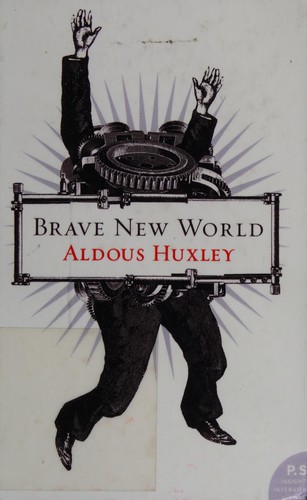
Brave New World
Brave New World, first published in 1932, imagines a World State that buys stability with engineered births, consumer pleasure, chemical comfort and the removal of family, religion and difficult art. Aldous Huxley follows a few people who begin to feel the strain: Bernard Marx, who is uneasy with his assigned place, and John, a young man raised outside the system and brought into it as a curiosity. Huxley's regime does not rule through open terror. It secures obedience through contentment, which sets the book apart from many better-known dystopian novels. Nearly a century on, it remains a standard reference point in arguments about technology, happiness and freedom. It is short enough to read in a few sittings.
Where to buy or borrow
Are you selling this book? Bookstores, publishers, authors and libraries can be listed here for free. Request a listing
About this book
Deep Overview
Huxley builds the setting before he builds a plot. Children are shaped by repeated sleep-teaching, Pavlov-style conditioning and play that normalises casual sex. Adults take the drug soma whenever discomfort threatens, and they fill their leisure with sensory entertainments and consumption. Words such as mother, father and family are treated as obscene. Nobody is imprisoned for thinking differently, because the system aims to prevent people from wanting differently.
The story gathers around a few figures who do not fit smoothly. Bernard Marx is an Alpha who feels out of place and resentful. Lenina Crown is a conventional, likeable citizen who is confused when Bernard behaves oddly. Helmholtz Watson is a gifted writer who finds that his society leaves him nothing meaningful to write about. A trip to a Savage Reservation in New Mexico brings Bernard and Lenina to John, who was born there to a woman originally from the World State. John has grown up on a mixture of tribal ritual, religious feeling and a battered volume of Shakespeare. Bernard brings him back to London, where he becomes a celebrity and then a casualty of a culture he cannot accept.
The book's last movement shifts from satire to argument. In a long conversation with Mustapha Mond, one of the ten World Controllers, John demands the right to be unhappy. Mond answers that his world gave up art, science for its own sake, religion and passion because they threaten stability. Huxley gives Mond's case real force, and he gives John's rebuttal real passion. He then lets the aftermath show that neither man's position offers a comfortable way out.
Huxley seems to be demonstrating that a society could lose its freedom without anyone being forced to surrender it. People may trade depth, risk and truth for ease, and may call the result progress. The book also implies that the supposed alternative, John's anguished and sometimes self-punishing world of feeling, is not simply a cure. The tension between those two unsatisfying options is where the book does most of its thinking.
Key Themes
Consumption as social control is a second theme. People are urged to buy, discard and replace, and leisure is organised so that it never leaves room for reflection. Stability depends on constant appetite and constant satisfaction.
The cost of removing family and intimacy runs through the book. Biological parenthood has vanished, and sex is public and casual. Attachments of every kind are discouraged, and the novel shows what that does to love, jealousy, loyalty and grief.
The book also weighs science and truth against social order. Mond admits that unrestricted inquiry and great art are dangerous because they unsettle people. The novel considers what a civilisation may sacrifice in the name of stability.
Language and literature carry much of the argument. John's Shakespeare gives him words for feelings that his new society cannot name, while the World State treats the same plays as unsuitable.
Finally, the novel treats caste and manufactured inequality as a design feature. People are conditioned to be satisfied with their place, so the hierarchy is stable and also, in the narrator's world, invisible.
Historical Context
He came from a prominent scientific and literary family, and the book belongs to a British interwar tradition of arguing about what science might do to society. His own earlier novels were satires of fashionable intellectual life, so the novel also reads as a joke that grows steadily more serious.
The title is taken from a line in Shakespeare's The Tempest, spoken in wonder by a character who has never seen society. Huxley uses it ironically. Many readers later set the book beside George Orwell's Nineteen Eighty-Four, published in 1949, as a contrasting vision of dystopia. In 1958 Huxley returned to his own predictions in Brave New World Revisited, a nonfiction assessment of how closely the world seemed to be following his imagined path.
Intended Audience
It may suit less well readers who want sustained suspense, a hero who prevails, or deeply developed characters. The people in the book are often vehicles for positions, and some of the satire is deliberately blunt. Readers who dislike frank treatment of sex, drugs and coercion should also be aware of those elements. The book regularly appears on challenged and banned book lists, and one school library catalogue lists this edition in a banned-books collection.
Reading Difficulty
Some vocabulary is invented, such as soma, hypnopaedia and Bokanovsky's Process. Other words are British and period-specific. Quotations from Shakespeare appear throughout and are easier to appreciate if you recognise them, but the plot can be followed without that knowledge.
This edition is a compact paperback of about 288 pages according to publisher-distributed data. It is a modern reprint of the 1932 text, and the pages have a standard layout with no special reading aids that we could confirm.
Helpful Background Knowledge
It also helps to know that the novel was published in the early 1930s, between the world wars, and that many of its ideas were reactions to the optimism and anxieties of that moment. Readers who plan to compare it with Nineteen Eighty-Four may want to read that book afterwards, so that each can be judged on its own terms first.
Why Read This Book?
It is also unusually compact. A reader can take in a whole fictional civilisation and a serious philosophical debate in a few sittings. Among science fiction books, it is a fine example of how the genre can be used to ask moral and political questions rather than to showcase technology.
Finally, it rewards rereading and discussion. Readers often disagree about who Huxley sides with, and the disagreement itself is a good way into the book.
Reader Takeaways
Readers may also notice how Huxley uses structure and irony: how comic scenes carry serious points, and how the final debate reframes everything that came before. Finally, the book invites readers to examine their own assumptions about which kinds of suffering are valuable and which are simply cruel.
Strengths
The book is short, tightly organised and endlessly discussable. It has remained in print and in conversation for generations because its central question, what we would give up for comfort, does not go out of date. Its irony also guards against the novel becoming a simple warning.
Its originality is significant. It helped define a form of dystopian satire that focuses on pleasure, consumption and conditioning rather than on violence alone.
Limitations and Cautions
The book reflects the assumptions of its time and author. Its treatment of caste, race and gender, and its depiction of the Reservation and its Indigenous inhabitants through an outsider's eyes, can feel stereotyped or dated to modern readers. Its frank treatment of sex, drugs and violence is the reason for many challenges to the book.
Readers also disagree on how to read it. Some see it as prophecy, others as a satire of Huxley's own era, and critics dispute how closely real technology and culture resemble his world. Mond's arguments are persuasive within the book, but they are the character's, not necessarily the author's. Finally, the Huxley foreword and any edition-specific introductory material vary between printings, so readers wanting that material should check the edition they buy.
Important Concepts, People, and Places
Henry Ford ("Our Ford"): the industrialist whose mass-production methods are treated as quasi-religious; the calendar counts years After Ford.
Bokanovsky's Process and the hatcheries: the technology of producing many identical embryos, central to the caste system.
Caste system (Alpha to Epsilon): the engineered hierarchy that assigns each person a role and a set of preferences.
Hypnopaedia and neo-Pavlovian conditioning: the sleep-teaching and early training that shape belief and desire.
Soma: the pleasant, side-effect-free drug that dissolves discomfort and keeps the population compliant.
Bernard Marx: an Alpha who feels alienated and whose resentment drives much of the plot.
Lenina Crown: a conventional citizen whose reactions show how deeply the conditioning runs.
Helmholtz Watson: a talented writer whose frustrations show what the society does to art.
John: the young man raised on the Savage Reservation, whose reading of Shakespeare shapes his moral outlook.
Linda: John's mother, who was born in the World State and stranded on the Reservation.
Mustapha Mond: the Resident World Controller who defends the system.
Savage Reservation (Malpais): the New Mexico enclave outside the World State where older customs and religion survive.
William Shakespeare and The Tempest: the source of the title and of the literary language John uses.
Brave New World Revisited: Huxley's 1958 nonfiction follow-up, in which he assessed his earlier predictions.
Questions the Book Explores
Can art, science and religion exist in a society that has no use for suffering? Is individuality a value worth protecting even when it causes pain?
What becomes of love, family and loyalty when they are treated as inefficient? And how far do our own habits of distraction, consumption and medication resemble those of the World State?
Reading Group Guide
It may help to split the discussion in three parts: the first six chapters for world-building, the middle chapters for Bernard, Lenina and the Reservation, and the final chapters for the Mond-John debate. Groups can reread that debate aloud to compare the two arguments.
Consider pairing the discussion with a short comparison to a later dystopia, or with Huxley's own 1958 follow-up essays. Since the book contains sexual content, drug use and a distressing ending, it is courteous to mention this when inviting new members.
Discussion Questions
2. Why does Huxley open with a tour of the hatchery rather than with a character?
3. How does the novel treat Bernard Marx? Is he a rebel, a hypocrite, or both?
4. What does John's attachment to Shakespeare reveal about the limits of his own worldview?
5. Does Mustapha Mond win the argument? What would a convincing reply look like?
6. Which aspects of the novel's world seem closest to, or furthest from, present-day life, and why?
7. What is lost and what is gained when family, religion and art are removed?
8. How does Huxley use humour, and when does it stop being funny?
9. How does the portrayal of the Reservation shape the book's argument, and where might it fall short?
10. What does the ending suggest about the alternatives the novel offers?
Sources and Verification
Page counts differ between sources: publisher-distributed and retailer data give 288 pages, while one library record describes 259 pages plus 20 preliminary pages. Whether this printing contains Huxley's later foreword or other introductory material was not confirmed, so the profile does not make claims about it.
Comments
No published comments yet.
Available editions
Paperback
Harper Perennial Modern Classics
- Publisher
- Harper Perennial
- ISBN-13
- 9780060850524
- Publication date
- Pages
- 288