
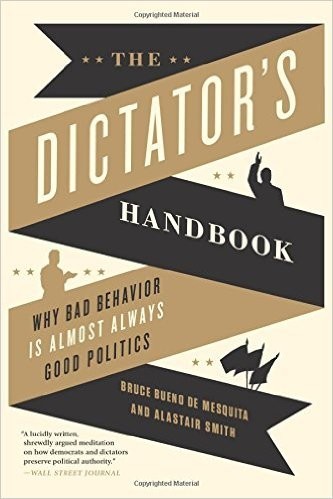
The Dictator's Handbook
Why Bad Behavior Is Almost Always Good Politics
The Dictator’s Handbook presents politics as a problem of survival rather than a contest between noble principles. Bruce Bueno de Mesquita and Alastair Smith argue that every leader—from an autocrat supported by a few generals to an elected president dependent on millions of voters—must maintain a coalition capable of keeping that leader in office. The size and replaceability of this coalition shape how rulers raise money, distribute benefits, tolerate corruption, provide public services, wage war, handle foreign aid, and respond to popular unrest. Small coalitions encourage private rewards for loyal insiders; large coalitions make broadly shared benefits more politically useful. Drawing examples from governments, municipalities, corporations, monarchies, and other organizations, the authors turn selectorate theory into an accessible framework for comparative politics. Their account is deliberately unsentimental: harmful conduct can be politically rational even when it is disastrous f…
Where to buy or borrow
Are you selling this book? Bookstores, publishers, authors and libraries can be listed here for free. Request a listing
About this book
Deep Overview
This framework shifts attention from a ruler’s personality to the incentives created by institutions. A leader dependent on a very small winning coalition can concentrate resources on generals, party officials, relatives, business allies, or other insiders. Because many potential replacements remain outside that inner circle, coalition members fear losing their privileges if the ruler falls. Their loyalty can therefore be maintained through private rewards and the threat of exclusion. Under these conditions, corruption, repression, selective taxation, and poor public services may weaken the country while strengthening the leader’s hold on office.
A ruler who needs a large coalition faces a different calculation. Paying millions of supporters individually is impractical, so public goods—reliable infrastructure, education, healthcare, legal protections, economic opportunity, and competent disaster response—become more efficient means of preserving support. The authors’ defense of democracy is consequently institutional rather than idealistic. Democratic government does not necessarily produce more virtuous politicians; it more often requires leaders to satisfy a larger portion of the population.
The argument extends into public finance and international affairs. Revenue matters because rulers need resources with which to reward their coalitions. Natural-resource income and foreign assistance can reduce dependence on productive, taxpaying citizens, allowing leaders to neglect public welfare while continuing to fund loyalists. War is likewise interpreted through political survival: leaders consider not only national victory but also how military performance, casualties, expenditure, and defeat could affect their tenure. Popular revolts become especially dangerous when security forces or other essential supporters decide that an incumbent is no longer their safest option.
Across cases involving figures such as Louis XIV, Mobutu Sese Seko, Saddam Hussein, Robert Mugabe, Jerry Rawlings, and Nelson Mandela, the authors ask readers to look past declarations of national purpose and identify the coalition beneath the rhetoric. They also apply the model beyond sovereign states, including corporations and municipal government, to suggest that coalition management is a general feature of organized power.
The final movement is reformist. If destructive behavior follows from political incentives, appeals to benevolence are unreliable. Durable improvement requires enlarging the group whose support matters, increasing competition, limiting discretionary resources, and designing aid or transition arrangements around predictable interests. The result is not simply a portrait of dictatorship. It is a theory of why institutions can make socially damaging conduct individually rational—and why better government depends on changing the political rewards attached to governing well.
Key Themes
• Coalition size: The number of indispensable supporters affects whether resources flow toward narrow privileges or widely shared services.
• Loyalty and replaceability: Insiders remain loyal not only because they receive benefits, but because losing the incumbent may also mean losing their privileged position.
• Public goods versus private rewards: Roads, schools, public health, legal order, and other broadly available goods become more politically attractive as the required support base expands.
• Corruption as an institutional outcome: The book treats corruption less as a failure of character than as a predictable method of maintaining a small ruling coalition.
• Revenue and accountability: Governments that depend on citizens for taxable production face different constraints from rulers financed by oil, minerals, monopolies, or external assistance.
• Democracy without romanticism: Democracy receives a conditional defense because broad coalitions align a leader’s survival more closely with mass welfare, not because elections eliminate self-interest.
• Reform through incentives: Sustainable change comes from altering who matters to rulers and what leaders must provide to remain in power.
Historical and Intellectual Context
Published originally in 2011, The Dictator’s Handbook appeared after a period of intense debate about democratization, authoritarian durability, foreign intervention, development assistance, and the political effects of natural-resource wealth. The Arab uprisings also made questions about protest, security-force loyalty, and regime survival especially visible. The revised 2022 edition situates the framework amid concern about illiberalism and democratic erosion.
The book also participates in a much older tradition associated with Niccolò Machiavelli: studying rulers as they act under competitive pressure rather than as political morality says they should act. Its distinctive contribution is to turn that realism into a comparative institutional model applicable to elected governments, dictatorships, monarchies, parties, cities, and corporations.
Intended Audience
Readers who enjoy provocative, thesis-driven nonfiction are likely to find it engaging. Those wanting a neutral survey of competing theories, detailed country histories, or a comprehensive account of ideology, identity, bureaucracy, and political culture may find its single-model approach too narrow. It is analytical rather than biographical and should not be approached as a practical manual for personal leadership.
Reading Difficulty
The repeated application of one framework makes the central logic easy to remember, although some readers may find the accumulation of cases or restatement of the model repetitive. Familiarity with twentieth- and early twenty-first-century politics helps, but the argument remains intelligible without specialist training. Readers should distinguish the book’s illustrative presentation from the statistical tests and formal models found in the associated academic literature.
Helpful Background Knowledge
Readers unfamiliar with game theory need only grasp that political actors respond to expected rewards, risks, and available alternatives. Those who want to evaluate the framework more critically may benefit from introductory material on comparative politics and from scholarship distinguishing personalist dictatorships, military regimes, monarchies, and single-party states.
Why Read This Book?
The book also offers an institutional argument for representative government without assuming that democratic politicians are unusually selfless. That makes it valuable for discussing why accountability sometimes produces competent government and why formally democratic procedures can still leave power concentrated. Even readers who ultimately reject its breadth may gain a sharper habit of tracing policy back to the supporters who can reward or remove decision-makers.
Reader Takeaways
The book also encourages skepticism toward personality-based accounts of government. Replacing one leader without changing the underlying support structure may reproduce similar conduct. Conversely, institutional changes that expand meaningful participation can alter what even a self-interested ruler must deliver.
Readers may also reconsider corruption, foreign aid, resource wealth, protest, and war as connected questions of political dependence. The broader lesson is that good intentions are fragile safeguards; arrangements that make public welfare useful to those in power are more dependable.
Strengths
The range of examples creates productive connections among comparative government, development, international relations, and organizational politics. The argument is candid about self-interest without ending in simple fatalism: institutional arrangements can change the behavior that political survival rewards. The accessible presentation gives general readers an entry point into a larger body of formal political-science research.
Limitations and Cautions
The book’s broad comparisons also compress complicated histories into short illustrations. A case that clarifies the model may not capture every important cause of the event being discussed. Readers should therefore treat the examples as demonstrations of a proposed mechanism rather than complete histories.
Selectorate theory itself is contested. Scholarly criticism has questioned how clearly selectorates and winning coalitions can be identified in authoritarian systems, whether their sizes can be measured reliably, and whether the model’s assumptions are too restrictive. The book is best read as a powerful analytical lens, not an uncontested law of politics. Because much of the original evidence predates the 2022 revision, some country descriptions should also be read in their historical timeframe.
Important Concepts, People, and Institutions
• Nominal selectorate or “interchangeables”: People with a formal role in choosing a leader, even when an individual member has little real influence.
• Real selectorate or “influentials”: Those whose participation actually affects leadership selection.
• Winning coalition or “essentials”: The minimum group whose continued support is necessary for the leader to remain in office.
• Private rewards: Targeted benefits—money, offices, contracts, protection, privileges—used to secure a limited number of supporters.
• Public goods: Broadly shared benefits such as security, infrastructure, education, public health, and legal order, which become more efficient politically when leaders need mass support.
• Loyalty norm: The tendency of coalition members to remain loyal when replacement by a rival could cost them access to benefits.
• Resource curse: The political danger that oil, minerals, or other concentrated revenues may free rulers from dependence on productive citizens and taxation.
• Bruce Bueno de Mesquita and Alastair Smith: Political scientists who translate selectorate theory from formal scholarship into the book’s general-audience argument.
• Randolph M. Siverson and James D. Morrow: Collaborators in the development of selectorate theory and coauthors, with Bueno de Mesquita and Smith, of The Logic of Political Survival.
• Mobutu Sese Seko, Saddam Hussein, and Robert Mugabe: Leaders used to illustrate how small-coalition rule can connect patronage, repression, and national decline to incumbent survival.
• Jerry Rawlings: Ghanaian leader whose economic and political changes serve the authors’ discussion of how financial pressures can alter governing incentives.
• Nelson Mandela and South Africa’s transition from apartheid: Invoked in considering negotiated transition, reconciliation, and incentives that may reduce violent resistance to surrendering power.
• Foreign aid: Examined as a transaction that may purchase policy concessions while inadvertently supplying rulers with resources independent of their citizens.
• Corporations and municipal governments: Nonstate examples used to show that the coalition framework is intended as a theory of organized power, not only national dictatorship.
Questions the Book Explores
• How does the number of indispensable supporters change patterns of taxation and spending?
• Why do some regimes provide public services while others concentrate wealth among insiders?
• Under what conditions does corruption become politically useful rather than merely tolerated?
• How can oil, minerals, and foreign assistance weaken accountability?
• What determines whether security forces defend a ruler or abandon that ruler during unrest?
• Why might democratic and autocratic leaders approach war differently?
• Can apparently democratic institutions still produce small, insulated coalitions?
• Why is replacing a ruler often insufficient to reform a political system?
• Which institutional changes can make good government compatible with political survival?
Reading Group Guide
Next, select two contrasting cases from the book and ask whether coalition structure explains more than conventional labels such as democracy, dictatorship, competent leadership, or corruption. Pay attention to moments when the same policy can benefit the public while also advancing an incumbent’s survival.
A productive discussion should separate descriptive claims from moral conclusions. The authors seek to explain why leaders behave as they do, but explanation does not itself justify the behavior. Groups can also compare the reform proposals with the theory’s darker diagnosis: do the proposed changes realistically redirect incentives, or do they underestimate the ability of elites to redesign institutions in their favor?
Finally, identify evidence that would falsify or substantially weaken the framework. This prevents the theory from becoming a story that appears to explain every possible result after the fact.
Discussion Questions
2. How clearly can the nominal selectorate, real selectorate, and winning coalition be identified in a modern democracy?
3. Why does a large winning coalition encourage public goods, and what conditions might interrupt that relationship?
4. Can corruption ever strengthen a state as well as a ruler, or are those interests ultimately incompatible?
5. How does the fear of losing privileges bind insiders to an incumbent they may privately dislike?
6. Does the framework explain corporate and civic organizations as convincingly as it explains governments?
7. How should foreign aid be designed if both donors and recipient leaders are primarily concerned with political survival?
8. What important forms of power are obscured when politics is reduced to material incentives and coalition maintenance?
9. Which example in the book most strongly supports its thesis, and which seems least adequately explained?
10. Can a leader enlarge the politically essential coalition without losing power in the process?
11. Are democratic institutions valuable mainly because of the incentives they create, or do norms and civic commitments matter independently?
12. What evidence would persuade you that selectorate theory is too broad or too narrow?
Sources and Verification
Comments
No published comments yet.
Available editions
Paperback
Revised edition; paperback
- Publisher
- PublicAffairs
- ISBN-13
- 9781541701366
- Publication date