Category

Government & Political Institutions

2 published books 0 published articles

Books in this category

Primary category

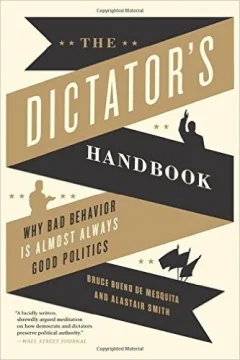
The Dictator's Handbook

Why Bad Behavior Is Almost Always Good Politics

By Bruce Bueno de Mesquita , Alastair Smith

The Dictator’s Handbook presents politics as a problem of survival rather than a contest between noble principles. Bruce Bueno de Mesquita and Alastair Smith argue that every leader—from an autocrat supported by a few generals to an elected president dependent on millions of voters—must maintain a coalition capable of keeping that leader in office. The size and replaceability of this coalition shape how rulers raise money, distribute benefits, tolerate corruption, provide public services, wage war, handle foreign aid, and respond to popular unrest. Small coalitions encourage private rewards for loyal insiders; large coalitions make broadly shared benefits more politically useful. Drawing examples from governments, municipalities, corporations, monarchies, and other organizations, the authors turn selectorate theory into an accessible framework for comparative politics. Their account is deliberately unsentimental: harmful conduct can be politically rational even when it is disastrous f…
View book

Related category

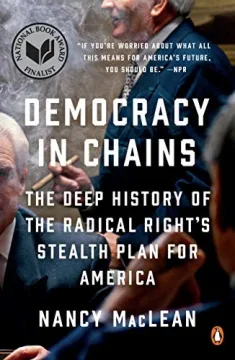
Democracy in Chains

The Deep History of the Radical Right’s Stealth Plan for America

By Nancy MacLean

Democracy in Chains is Nancy MacLean’s history of the ideas, institutions, and donors that she argues transformed the American libertarian right into a campaign to restrict majority rule. Its central figure is James McGill Buchanan, the economist associated with public choice theory and constitutional political economy. MacLean follows his career from Virginia’s battles over school desegregation through the growth of university centers and donor-supported policy organizations, culminating in his relationship with Charles Koch’s political network. Her central contention is that an organized movement sought not merely to win elections but to rewrite governing rules so that taxation, regulation, unions, public education, and social programs would become harder for popular majorities to sustain. The book connects intellectual history to practical politics, asking how private wealth can reshape democratic institutions. It is also a sharply contested interpretation: scholars have disputed M…

View book

Articles in this category

No published articles are currently connected to this category in this language.