
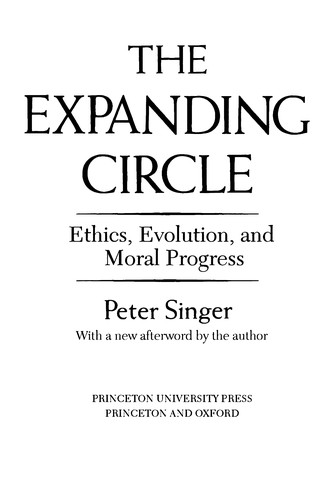
The Expanding Circle
Ethics, Evolution, and Moral Progress
Why do human beings help one another, and how can concern extend beyond family, community, or nation? Peter Singer approaches these questions by bringing evolutionary accounts of altruism into conversation with moral philosophy. Biology, he argues, helps explain the origins and limits of many social impulses: natural selection can favor assistance to relatives, reciprocal cooperation, and loyalty within groups. Yet an evolutionary explanation of conduct does not by itself determine how anyone ought to live. Singer assigns a decisive role to reason, whose demand for consistency can expose the arbitrariness of privileging one’s own group simply because it is one’s own. The resulting image is an expanding circle of moral concern, potentially widening from kin and neighbors to distant strangers and nonhuman animals. Originally published amid intense debate over sociobiology, the book remains a compact argument about human nature, impartiality, and whether moral progress is possible.
Where to buy or borrow
Are you selling this book? Bookstores, publishers, authors and libraries can be listed here for free. Request a listing
About this book
Deep Overview
This explanatory success creates a philosophical danger. If evolutionary biology can account for moral feelings and practices, one might conclude that it can replace ethical reflection or tell us what is right. Singer rejects that move. An account of why a disposition evolved is not yet a justification for obeying it. Evolution may explain strong attachments to relatives, hostility toward outsiders, or intuitive reactions to particular dilemmas; it does not follow that these tendencies deserve moral authority. Biology supplies facts about human capacities and recurring desires, but an ethical conclusion requires additional reasoning.
The book’s central constructive claim concerns the universalizing pressure within moral thought. Once people justify conduct by giving reasons, those reasons become open to challenge from others who occupy relevantly similar positions. A person may naturally care more about a member of the same family or community, but the bare fact that someone belongs to “my” group cannot establish that person’s interests are objectively more important. Consistent reasoning pushes against such arbitrary preference and toward a more impartial standpoint.
Singer’s expanding circle is therefore neither a claim that sympathy automatically becomes universal nor a prediction of uninterrupted historical improvement. It describes how a limited social capacity can be redirected and enlarged through reflection, argument, cultural practices, and institutions. Moral concern may move beyond kin to tribe, nation, humanity, and sentient beings outside the human species. The circle can also contract, and inherited loyalties remain powerful.
The closing argument seeks a practical accommodation between reason and evolved human nature. Ethics cannot plausibly demand that people cease having intimate attachments or local commitments. Nor should those attachments be treated as the final boundary of obligation. A workable moral culture would build on cooperative tendencies while encouraging broader concern and restraining parochial impulses. The 2011 afterword revisits this framework using later discussions of moral psychology and evolution, preserving the book’s core distinction between explaining an intuition and justifying it.
Key Themes
• **Explanation versus justification:** Discovering the biological origin of an impulse does not show that acting on it is right. Singer treats this separation as essential to avoiding a biological takeover of ethics.
• **Reason and consistency:** Moral reasoning asks people to apply comparable standards to comparable interests, making arbitrary favoritism increasingly difficult to defend.
• **Impartiality:** The ethical point of view requires some movement beyond personal and group preference, even though complete emotional neutrality may be psychologically unrealistic.
• **Moral progress:** Progress can involve enlarging the class of beings whose interests receive serious consideration, but Singer does not portray expansion as automatic or irreversible.
• **Human nature and ethical culture:** Durable moral systems must acknowledge evolved desires and attachments while cultivating forms of concern that exceed their original scope.
Historical and Intellectual Context
Singer enters between blanket rejection and biological reductionism. He accepts that evolutionary theory can illuminate the origins of cooperation and moral feeling, but denies that science can derive obligations from those origins. The argument belongs to a longer philosophical dispute over the relation between facts and values and also draws upon traditions of universalist and utilitarian ethics. The 2011 edition reflects a later intellectual setting in which evolutionary psychology, experimental moral psychology, neuroscience, and evolutionary debunking arguments had made questions about the origins of moral judgment increasingly prominent.
Intended Audience
Reading Difficulty
Helpful Background Knowledge
Why Read This Book?
Reader Takeaways
Strengths
Limitations and Cautions
Important Concepts and People
• **Altruism:** Behavior that benefits another at some cost or risk to the actor. The book distinguishes biological accounts of altruistic behavior from moral praise and consciously impartial action.
• **Kin selection:** An evolutionary explanation for assistance directed toward genetic relatives. It helps explain why concern may first be strongest within families.
• **Reciprocal altruism:** Cooperation sustained because assistance may later be returned. It helps account for social conduct beyond close kin while retaining an evolutionary benefit.
• **Sociobiology:** The systematic study of the biological bases of social behavior. Singer treats it as ethically relevant but insufficient to establish moral principles.
• **Reason:** For Singer, the capacity that tests principles for consistency and presses beyond an exclusively personal or tribal standpoint.
• **Impartiality:** The demand not to discount comparable interests solely because they belong to someone outside one’s favored group.
• **Moral progress:** Change that removes arbitrary exclusions and extends serious consideration to a wider set of interests; the book presents expansion as possible, not inevitable.
• **E. O. Wilson:** The biologist whose work on sociobiology provided a major intellectual catalyst for the original book and for debates over whether biology could absorb ethics.
• **Charles Darwin:** The foundational figure for the evolutionary framework within which altruism, social instincts, and human moral capacities are discussed.
• **Henry Sidgwick:** A major utilitarian philosopher relevant to Singer’s ideal of viewing interests from an impartial ethical standpoint.
• **Nonhuman animals:** A crucial test of whether species membership is a defensible boundary for moral concern.
Questions the Book Explores
• What do kinship, reciprocity, and group life explain about human morality?
• Can facts about evolved behavior determine what people ought to do?
• When does an evolutionary account undermine rather than support a moral intuition?
• Why does giving reasons create pressure toward consistency and impartiality?
• Can rational reflection extend concern beyond those toward whom people naturally feel sympathy?
• How should ethical cultures work with persistent human desires rather than assume they can abolish them?
• Is widening moral inclusion an adequate account of moral progress?
Reading Group Guide
A second productive angle is the metaphor itself. Ask whether a circle captures the shape of moral development, or whether competing values sometimes require revision, conflict, or institutional change rather than simple inclusion. Groups can also test the framework against family duties, nationalism, racial exclusion, global poverty, animal welfare, and obligations to future generations. Conclude by discussing the practical problem Singer raises: how can cultures encourage broader concern without destroying valuable personal attachments?
Discussion Questions
2. Does consistency in reasoning necessarily lead toward impartiality, or can coherent ethical systems privilege special relationships?
3. Which human attachments should ethics preserve even when they conflict with equal concern?
4. Can knowledge that an intuition has an evolutionary origin give us reason to distrust it? Under what conditions?
5. Is the expanding circle an accurate description of historical moral progress, an ethical ideal, or both?
6. What examples suggest that the moral circle can contract as well as expand?
7. Should nonhuman animals be understood as the next extension of an existing principle, or does their inclusion require a different argument?
8. Does Singer underestimate the moral importance of emotion, tradition, or community?
9. How might institutions encourage concern for distant strangers more effectively than individual reflection alone?
10. What dimensions of moral progress cannot be captured by wider inclusion?
Sources and Verification
Comments
No published comments yet.
Available editions
Paperback
First Princeton University Press paperback edition, with a new preface and afterword
- Publisher
- Princeton University Press
- ISBN-13
- 9780691150697
- Publication date