
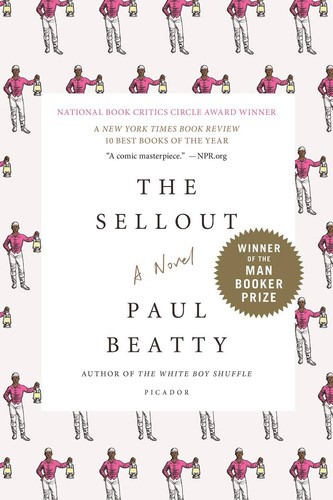
The Sellout
A Novel
Paul Beatty’s The Sellout is a ferocious comic novel about race, belonging, and the contradictions hidden inside American ideals. Its unnamed Black narrator lives in Dickens, a fictional community on the southern edge of Los Angeles that has been erased from official maps. Convinced that restoring the town requires drastic action, he attempts to reintroduce segregation and becomes entangled in an arrangement that others interpret as slavery. The resulting case carries him to the United States Supreme Court. Beatty uses this deliberately outrageous premise to examine racial identity, civic neglect, educational inequality, policing, historical memory, and the consolations offered by simplistic stories of progress. The novel’s jokes are dense, abrasive, and inseparable from its serious questions: Who is allowed to define a community? What does equality mean when institutions remain unequal? And what happens when the language of racial transcendence obscures the persistence of racism?
Where to buy or borrow
Are you selling this book? Bookstores, publishers, authors and libraries can be listed here for free. Request a listing
About this book
Deep Overview
Dickens is fictional, but its place within greater Los Angeles gives it recognizable social and historical weight. It is a predominantly Black and Latino community suffering from civic abandonment, unstable boundaries, and official disappearance. When Dickens is removed from maps, its erasure becomes more than a municipal absurdity. Beatty turns it into a question about who receives public recognition and whether a community still exists politically when authorities decline to name it.
The narrator has inherited a complicated intellectual burden from his father, F. K. Me. A psychologist and controversial community figure, the elder Me subjected his son to experiments and treated everyday life as raw material for theories about Black behavior. His death in a police shooting leaves the narrator with grief but no promised scholarly legacy capable of explaining either their relationship or American racism. The son’s agricultural work initially appears to offer a retreat from ideology, yet his effort to recover Dickens draws him into increasingly theatrical forms of social engineering.
Hominy Jenkins, an aging performer associated with the fictionalized Little Rascals films, becomes central to that escalation. Having internalized the humiliating roles through which he once received attention, Hominy demands subordination as a source of identity. The narrator does not simply impose slavery upon him; their disturbing relationship involves need, performance, historical repetition, and moral evasion. Beatty thereby prevents the premise from becoming a clean allegory with one obvious target.
The narrator’s segregation campaign is similarly paradoxical. It arises amid failing institutions and becomes, in part, an attempt to give neglected residents a tangible boundary against which to organize themselves. That does not make segregation defensible. Instead, the contradiction exposes how abstract celebrations of integration can coexist with material inequality, neighborhood abandonment, and schools that are integrated in principle but stratified in practice.
Other figures widen the argument. Marpessa, the narrator’s former partner and a bus driver, connects personal intimacy to the city’s racial and geographic divisions. The Dum Dum Donut Intellectuals parody public debate that turns Black experience into rhetorical performance. Their arguments, revisions of canonical texts, and disagreements about acceptable language dramatize a larger struggle over who controls representation.
The Supreme Court proceedings ultimately bring the local experiment into confrontation with constitutional language and national mythology. Yet the book offers no tidy doctrine. Its method is to make incompatible truths collide: legal equality and lived inequality, communal solidarity and exclusion, historical memory and nostalgia, self-definition and stereotype. The comedy does not dissolve these conflicts; it makes their absurdity and persistence harder to ignore.
Key Themes
• **Visibility and civic erasure:** Dickens’s removal from maps represents the political consequences of being unnamed, uncounted, or treated as disposable. The campaign to restore it is also a struggle over who has the power to define place.
• **Segregation, integration, and unequal institutions:** Beatty distinguishes legal ideals from material conditions. The book asks whether integration can be celebrated as an achievement while schools and neighborhoods remain deeply stratified.
• **Performance and racial identity:** Characters repeatedly perform versions of Blackness for institutions, audiences, one another, and themselves. Hominy’s attachment to degrading entertainment roles makes performance both a survival strategy and a form of captivity.
• **Language and euphemism:** Arguments over offensive words, literary revision, and public respectability show that changing vocabulary may alter social perception without necessarily changing power.
• **Fathers, inheritance, and failed explanations:** The narrator inherits his father’s experiments and theories but not a reliable account of what their lives mean. Their relationship questions whether social theory can explain the emotional damage it helps produce.
• **Satire without moral comfort:** The book resists dividing its world into enlightened and ignorant camps. Nearly every position is exposed to contradiction, including positions that present themselves as progressive.
Historical and Cultural Context
Its deeper background includes slavery, Jim Crow segregation, school desegregation, restrictive housing practices, redlining, urban renewal, and the shifting racial geography of metropolitan Los Angeles. Dickens’s disappearance also evokes the vulnerability of communities whose political identity can be weakened by administrative decisions, redevelopment, or gentrification.
Hominy’s career recalls the history of Black performers working within entertainment traditions built around caricature. His nostalgia is therefore intentionally troubling: personal recognition and collective humiliation have become difficult for him to separate.
The Supreme Court frame invokes the authority of constitutional interpretation, especially debates surrounding equal protection and state-enforced segregation. Beatty places that formal legal tradition beside the improvised realities of an abandoned neighborhood, forcing national principles to confront conditions they do not neatly resolve.
Intended Audience
It is also productive for university courses and reading groups discussing American literature, racial representation, constitutional ideals, Los Angeles, or the limits of satire. Readers who prefer linear plots, sympathetic characters presented without ambiguity, or gentle comedy may find it demanding. Its frequent use of racial slurs, sexual language, stereotypes, and deliberately offensive scenarios makes it unsuitable for anyone seeking an emotionally comfortable treatment of racism.
Reading Difficulty
The chronology is not strictly linear, and the Supreme Court opening initially withholds much of the context needed to understand the alleged offenses. The reader must also distinguish a character’s argument from the novel’s broader satirical purpose; taking every statement as the author’s direct position will flatten the book’s deliberate contradictions.
No specialist academic training is required, but the density rewards slow reading and occasional rereading. Familiarity with American racial history and Los Angeles adds depth, while readers encountering those subjects for the first time may want supplementary historical context.
Useful Background Knowledge
Some awareness of Los Angeles County’s fragmented municipal geography is also helpful. Dickens is invented, yet its combination of agricultural remnants, racial diversity, civic neglect, and proximity to better-known cities draws meaning from Southern California’s real spatial inequalities.
The novel contains numerous references to African American literature, popular entertainment, psychology, public intellectual culture, and canonical American writing. Recognizing every allusion is unnecessary. More important is noticing when a familiar cultural object is being revised, sanitized, or weaponized in an argument about race.
Why Read This Book?
It also offers an unusual literary portrait of metropolitan Los Angeles. Rather than treating the city as a collection of famous districts, Beatty focuses on borders, transit routes, forgotten histories, and communities vulnerable to official disappearance. Finally, the novel demonstrates what comic fiction can accomplish when humor is not an escape from painful history but a way of approaching claims that polite discourse has made difficult to examine.
Reader Takeaways
Readers may also reconsider the meaning of belonging. Dickens’s residents are united partly by neglect and by the need to defend a place that authorities have erased. Their situation suggests that communities depend not only on geography but also on memory, naming, shared institutions, and conflict.
The book further sharpens awareness of how stereotypes operate. They are not presented solely as false images imposed from outside; characters may resist, perform, revise, or even seek refuge in them. That complexity makes identity appear negotiated rather than fixed. Above all, the novel demonstrates that laughter and discomfort can coexist without canceling one another.
Strengths
Its fictional geography is another strength. Dickens operates as a particular neighborhood, a contested map, and a model of institutional neglect without becoming a simple symbol. The supporting characters embody competing responses to racial history rather than serving only as mouthpieces for one thesis.
The structure also gives the satire consequence. By beginning at the Supreme Court, Beatty places private absurdities within a national argument about equality and law. The result is a work capable of joining local politics, family history, popular culture, and constitutional mythology in one restless narrative.
Limitations and Cautions
Several characters are rendered through exaggeration because caricature is central to the book’s method. That approach can limit psychological intimacy, especially for readers seeking fully naturalistic development. Women are important to the narrator’s life and the social world of Dickens, but the novel remains strongly centered on his perspective.
The treatment of slavery, segregation, racial slurs, police violence, and degrading performance is intentionally abrasive. Context does not eliminate the potential harm or alienation produced by that language. Finally, the book diagnoses contradictions more readily than it proposes remedies. Readers looking for a practical program of racial justice will not find one here.
Important Concepts, People, Places, and Institutions
• **Dickens, California:** The fictional community near Los Angeles whose removal from maps motivates the narrator’s campaign. It concentrates the novel’s concerns with place, civic recognition, racial geography, and abandonment.
• **F. K. Me:** The narrator’s father, a psychologist who turns his son into the subject of behavioral experiments. His theories and death shape the narrator’s understanding of race, authority, and inheritance.
• **Hominy Jenkins:** An elderly actor associated with racist screen caricatures who asks to become the narrator’s slave. His demand makes him a disturbing figure of nostalgia, dependency, performance, and internalized degradation.
• **Marpessa Dawson:** The narrator’s former partner and a bus driver. Her movements through Los Angeles connect intimate relationships to transit, class, and the city’s divided geography.
• **The Dum Dum Donut Intellectuals:** A group of local Black thinkers whose debates parody the performance of public expertise and disputes over acceptable racial representation.
• **The United States Supreme Court:** The institutional frame for the narrator’s trial. It brings Dickens’s local crisis into contact with constitutional ideals and the national legal history of race.
• **Segregation and desegregation:** The novel treats these not only as legal arrangements but also as contested social experiences shaped by schools, neighborhoods, belonging, and unequal resources.
• **Cartographic erasure:** Dickens’s disappearance from maps represents the loss of official recognition. Mapping becomes a political act that determines which communities count.
• **Post-racialism:** The belief that racial divisions have been substantially overcome. Beatty subjects this idea to sustained ridicule by contrasting optimistic language with persistent inequality.
Questions the Book Explores
• Who has the authority to decide whether a community exists?
• When does the performance of a stereotype become survival, and when does it reinforce degradation?
• Can integration become an empty symbol when it is not accompanied by material justice?
• Why might a person seek identity or recognition through a role that is visibly humiliating?
• Does replacing offensive language change the structures and histories carried by that language?
• What responsibilities arise when grief, inherited theory, and community neglect shape political action?
• Can satire criticize racism without reproducing some of its injuries?
• What does it mean to belong to a nation whose official ideals and ordinary practices repeatedly diverge?
Reading Group Guide
Map the different forms of erasure in the story: Dickens’s cartographic disappearance, the suppression or revision of offensive language, Hominy’s fading cultural memory, and the absence of the father’s promised intellectual legacy. Consider whether these losses are comparable or fundamentally different.
Track the narrator’s explanations for segregation. Separate his stated motives from the effects of his actions and from the likely judgment of the reader. This distinction can help a group avoid reducing the novel to either endorsement or straightforward condemnation.
Compare the book’s institutions—the school, police, transit system, local intellectual circle, municipal authorities, and Supreme Court. Ask which institutions produce belonging and which merely claim to represent it.
Because the humor may divide readers, invite members to identify one episode they found revealing and one they found excessive or ethically troubling. The disagreement itself can open a useful discussion about audience, permission, and the risks of satire.
Discussion Questions
2. What does farming contribute to the narrator’s identity, and how does it differ from his father’s psychological theories?
3. Is restoring Dickens primarily an act of community preservation, personal grief, political protest, or something else?
4. How should readers interpret Hominy’s insistence on enslavement without denying either his agency or the historical violence of the role?
5. What does Marpessa understand about the narrator and Los Angeles that he does not fully understand himself?
6. How does the novel distinguish between integration as a principle and integration as a lived social condition?
7. Which targets of the Dum Dum Donut Intellectuals’ debates seem most important to Beatty’s criticism of public discourse?
8. When does the novel’s use of caricature expose stereotypes, and when might it risk repeating them?
9. Does the narrator change substantially, or does the reader’s interpretation of him change instead?
10. What forms of recognition do Dickens and its residents seek, and why are official maps so important to that struggle?
11. How does the book complicate the difference between coercion and consent?
12. What, if anything, does the final movement suggest about racial progress and the desire to declare victory?
Sources and Verification
Comments
No published comments yet.
Available editions
Hardcover
First United States edition; hardcover
- Publisher
- Farrar, Straus and Giroux
- ISBN-13
- 9780374260507
- Publication date
- Pages
- 288