
Category

Archaeology & Ancient Civilizations

Books about ancient civilizations and the search for lost worlds. Mary Beard's SPQR tells the history of ancient Rome's first thousand years, how a small town in central Italy became an empire, using archaeology and ancient texts, and questioning the myths Rome told about itself. David Grann's The Lost City of Z follows the British explorer Percy Fawcett, who vanished in the Amazon in 1925 searching for an ancient city, and the archaeological evidence that complex societies did exist there. For readers fascinated by the ancient past. See History & Society for more.

2 published books 0 published articles

Books in this category

Related category

SPQR

A History of Ancient Rome

By Mary Beard

Mary Beard's SPQR examines how a small settlement in central Italy became the center of a vast and durable imperial system. Moving from Rome's uncertain beginnings and foundation legends through the Republic and early Empire, Beard asks how Roman power worked, who counted as Roman, and how conquest transformed both rulers and subjects. The account gives major figures such as Cicero, Julius Caesar, Augustus, and Caracalla their place without reducing Roman history to a procession of celebrated men. Political institutions, slavery, citizenship, migration, family life, religion, urban conditions, and social inequality are integral to the story. Beard also repeatedly exposes the difficulty of reconstructing antiquity from partisan texts, monumental self-presentation, inscriptions, coins, and incomplete archaeology. Ending in 212 CE, when Caracalla extended citizenship to almost all free inhabitants of the empire, SPQR presents Rome as a changing political community rather than a fixed mod…
View book

Related category

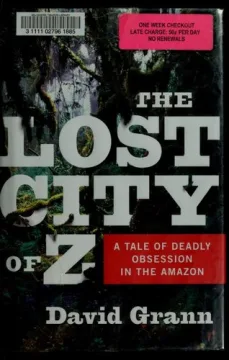
The Lost City of Z

A Tale of Deadly Obsession in the Amazon

By David Grann

In 1925, British explorer Percy Harrison Fawcett entered Brazil’s Mato Grosso with his son Jack and Jack’s friend Raleigh Rimell. They were searching for evidence of an ancient Amazonian society that Fawcett called “Z.” None returned. David Grann reconstructs the expedition, the career that led Fawcett toward it, and the succession of investigators and adventurers who tried to solve the disappearance. He also follows Fawcett’s trail himself, turning the investigation into a meeting point between biography, travel reporting, historical mystery, and archaeology. The result is not merely a survival story. It examines how imperial assumptions shaped exploration, why outsiders long underestimated Indigenous Amazonian societies, and how a powerful idea can consume both its originator and later seekers. Grann preserves the uncertainty surrounding Fawcett’s fate while showing that his broad conviction—that the Amazon once supported complex, settled communities—deserved more serious considerat…

View book

Articles in this category

No published articles are currently connected to this category in this language.