
WebToTell

Books

Discover published books from independent authors and publishers.

Explore the library

Find your next book

77 unique books found Books may appear in more than one category.

The Covenant of Water book cover

The Covenant of Water

By Abraham Verghese

A Novel

The Covenant of Water is a large-scale historical novel following three generations of a Christian family in Kerala, southwestern India, from 1900 through 1977. Its central thread begins with a twelve-year-old girl who enters an arranged marriage and eventually becomes the family matriarch known as Big Ammachi. Over her long life, personal relationships, medical crises, births, losses, and inherited secrets become intertwined with the transformation of Kerala under colonial rule and after Indian independence. A recurring family fear gives the narrative its mystery: in successive generations, someone appears unusually vulnerable to drowning. Water therefore operates simultaneously as landscape, threat, connective medium, and metaphor. Kerala's rivers, canals, lagoons, rain, and backwaters shape everyday movement while the family's supposed affliction turns that environment into a source of apprehension. The novel does not proceed only as a single-family chronicle. It opens additional n…

View The Covenant of Water

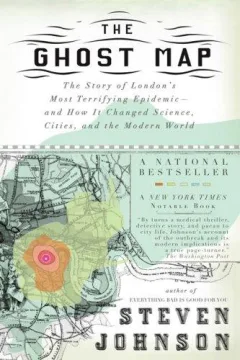
The Ghost Map book cover

The Ghost Map

By Steven Johnson

The Story of London’s Most Terrifying Epidemic—and How It Changed Science, Cities, and the Modern World

The Ghost Map reconstructs the severe cholera outbreak that struck London’s Soho district in late August and early September 1854. Steven Johnson organizes much of the central narrative chronologically, following the epidemic from its first households through the investigation of the Broad Street water pump. Physician John Snow supplies the analytical framework: already skeptical of the dominant belief that cholera traveled through foul air, he gathers addresses, water-use histories, mortality patterns, and exceptions that might support or undermine a waterborne explanation. The Reverend Henry Whitehead contributes a different but complementary form of knowledge—close familiarity with neighborhood residents and the willingness to conduct extensive household inquiries. Johnson presents their eventual collaboration as an example of formal analysis strengthened by local, social intelligence. The book then widens its scale. It examines Victorian waste disposal, overcrowding, water infrast…

View The Ghost Map

The Mushroom at the End of the World book cover

The Mushroom at the End of the World

By Anna Lowenhaupt Tsing

On the Possibility of Life in Capitalist Ruins

This interdisciplinary work follows matsutake mushrooms from disturbed forests into an international commodity network centered on Japanese demand. Tsing moves among mushroom ecologies, forest management, migration histories, commercial picking, scientific research, wholesale trade, and cultural practices of exchange. Rather than treating the commodity chain as a single orderly system, she presents it as a collection of locally distinct social and ecological worlds that meet only partially. The Oregon matsutake trade receives sustained attention. Its pickers include Southeast Asian refugees and immigrants, Indigenous participants, military veterans, and others seeking livelihoods or autonomy outside conventional employment. The book connects their activities to buyers, exporters, Japanese importers, scientists, land managers, trees, fungi, and landscapes shaped by logging and other disturbances. Comparative material from Japan, China, and Finland expands the inquiry beyond one forest…

View The Mushroom at the End of the World

The Wager book cover

The Wager

By David Grann

A Tale of Shipwreck, Mutiny and Murder

The Wager reconstructs the disastrous voyage of HMS Wager, a British warship sent into the Pacific as part of Commodore George Anson’s expedition during the War of Jenkins’ Ear. After disease, storms, navigational hazards, and separation from the squadron, the ship was wrecked off the coast of Chilean Patagonia in 1741. The survivors then faced hunger, exposure, internal division, collapsing discipline, disputed authority, violence, and an eventual break with Captain David Cheap. Grann follows the castaways’ rival escape attempts and their extraordinary returns to civilization, where competing factions published incompatible accounts and accused one another of mutiny and other crimes. The closing movement shifts from survival narrative toward legal and historical inquiry: what could the Admiralty acknowledge, what might it prefer to suppress, and whose testimony would become accepted history? Grann builds the account from logbooks, correspondence, diaries, published narratives, court-…

View The Wager

The Sympathizer book cover

The Sympathizer

By Viet Thanh Nguyen

The Sympathizer is a literary espionage novel framed as the confession of an unnamed Vietnamese narrator being held and interrogated. A communist agent embedded in the South Vietnamese military, he escapes Saigon with a general and other refugees in April 1975, resettles in Southern California, and continues reporting to his revolutionary contact. His divided assignment forces him to betray people he loves while participating in an exile community that regards communist victory as catastrophe. The novel moves beyond conventional spy suspense by making divided consciousness its central method. The narrator is Vietnamese and partly French, communist and American-educated, observer and participant, betrayer and loyal friend. His ability to recognize competing perspectives gives him unusual insight, but it does not grant moral freedom. Instead, every allegiance creates another obligation he cannot satisfy. The narrative expands from the fall of Saigon and refugee resettlement into politic…

View The Sympathizer

The Great Transformation book cover

The Great Transformation

By Karl Polanyi

The Political and Economic Origins of Our Time

Polanyi sets out to explain the breakdown of nineteenth-century European civilization and the political disasters that followed it. His account connects four institutions: the balance-of-power system, the international gold standard, the liberal state, and—most importantly—the ideal of a self-regulating market. Rather than treating markets as timeless or naturally dominant, he distinguishes ordinary markets from a market society in which production and social life are organized around market prices. The book moves across diplomatic history, industrialization, English poor relief, classical political economy, labor legislation, monetary institutions, imperialism, depression, fascism, and socialism. Its governing argument is that constructing a self-regulating market required extensive political intervention and the treatment of labor, land, and money as commodities. Because those elements are inseparable from human beings, nature, and public institutions, unrestricted commodification g…

View The Great Transformation

The Poisonwood Bible book cover

The Poisonwood Bible

By Barbara Kingsolver

A Novel

The Poisonwood Bible follows the Price family, white Southern Baptists who travel from Georgia to the Belgian Congo in 1959. Nathan Price regards the mission as an opportunity to impose religious certainty on the village of Kilanga, while his wife, Orleanna, and their four daughters—Rachel, Leah, Adah, and Ruth May—experience their new surroundings through sharply different temperaments. The novel excludes Nathan from its rotating first-person narration. Readers instead encounter his authority through the women and girls who must live with its consequences. The family story unfolds beside the Congo’s transition from Belgian rule to independence, the crisis surrounding Patrice Lumumba, and the eventual rise of Mobutu. Domestic conflict and political history continually illuminate one another: Nathan’s refusal to listen becomes a small-scale image of missionary paternalism and foreign intervention, while the Price women’s divergent lives show several possible responses to complicity, di…

View The Poisonwood Bible

The Devil in the White City book cover

The Devil in the White City

By Erik Larson

Murder, Magic, and Madness at the Fair That Changed America

Erik Larson reconstructs two histories unfolding in and around Chicago during the early 1890s. The larger strand follows architect Daniel H. Burnham and the formidable effort to design, finance, construct, and open the World’s Columbian Exposition of 1893. Burnham must coordinate prominent architects, landscape designer Frederick Law Olmsted, engineers, laborers, civic leaders, and exhibitors while confronting deadlines, weather, economic instability, construction accidents, and the death of his partner John Root. The second strand follows Herman Webster Mudgett, better known as H. H. Holmes, a physician, swindler, bigamist, and murderer operating not far from the fairgrounds. Larson alternates between these narratives rather than treating the fair as background decoration for a conventional crime account. The result is a study in contrasting forms of ambition: Burnham’s public, collaborative effort to create a temporary ideal city and Holmes’s private manipulation of people, property…

View The Devil in the White City

The Ministry for the Future book cover

The Ministry for the Future

By Kim Stanley Robinson

A Novel

Kim Stanley Robinson’s near-future novel examines climate change as a crisis of institutions, economics, technology, justice, and collective action rather than as a single disaster with a single solution. It opens with a lethal heat wave in India, experienced by aid worker Frank May, and follows the psychological and political consequences of that catastrophe. A second central thread concerns Mary Murphy, the head of an international body informally called the Ministry for the Future, whose mandate is to represent future generations and living beings that lack political power in the present. The book gradually expands beyond Frank and Mary into a global systems narrative. It moves among central bankers, climate scientists, activists, refugees, lawyers, agricultural communities, engineers, political officials, and covert organizations. Conventional scenes are interspersed with testimony, reports, meeting notes, explanatory passages, dialogues, and nonhuman or conceptual voices. This co…

View The Ministry for the Future

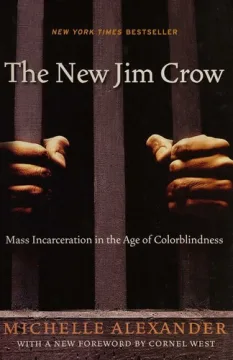
The New Jim Crow book cover

The New Jim Crow

By Michelle Alexander

Mass Incarceration in the Age of Colorblindness

Michelle Alexander argues that the extraordinary expansion of the United States criminal legal system—especially through the War on Drugs—created a durable structure of racial control after the formal dismantling of Jim Crow segregation. Her argument is not simply that individual officials may be prejudiced or that racial disparities are unfortunate side effects. She maintains that ostensibly race-neutral laws, discretionary policing, prosecutorial power, plea bargaining, sentencing policy, and the continuing penalties attached to a criminal record operate together as a system. The book begins by placing mass incarceration within a longer history of racial hierarchy, moving from slavery through Reconstruction, Jim Crow, and the late-twentieth-century politics of crime. It then explains how drug enforcement and criminal procedure give police and prosecutors broad discretion while courts make proof of systemic racial discrimination exceptionally difficult. Alexander follows people beyon…

View The New Jim Crow

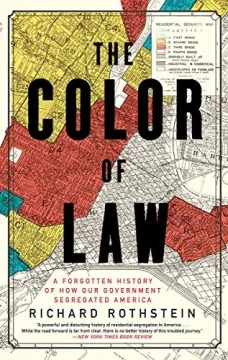
The Color of Law book cover

The Color of Law

By Richard Rothstein

A Forgotten History of How Our Government Segregated America

The book presents a historical and constitutional argument about residential segregation in the United States. Richard Rothstein disputes the familiar description of metropolitan segregation as merely de facto—that is, arising through private prejudice, household preference, economic inequality, or market behavior without decisive government involvement. He argues that federal, state, and local authorities repeatedly imposed, reinforced, or protected racial separation, making much of the resulting geography de jure segregation. ([guides.loc.gov](https://guides.loc.gov/real-estate-industry-sources/residential/fair-housing?utm_source=openai)) Rothstein builds this case through connected examples rather than a single-city history. He examines racially explicit zoning, segregated public housing, discriminatory federal mortgage policy, suburban development restricted to white purchasers, tax and land-use decisions, official tolerance of violence against integrating families, and public act…

View The Color of Law

Invisible Women book cover

Invisible Women

By Caroline Criado Perez

Data Bias in a World Designed for Men

Invisible Women examines what happens when institutions treat male bodies, routines, and experiences as the human norm. Caroline Criado Perez calls attention to a “gender data gap”: missing, unreported, or insufficiently separated information about women. Her central argument is not merely that women are absent from datasets. It is that decisions made from incomplete evidence can turn that absence into material disadvantages—including unsuitable products, ineffective public services, distorted economic measurements, and avoidable health and safety risks. The book moves from ordinary environments to increasingly consequential systems. Its six parts address daily life, employment, design, medicine, public life, and disasters. Examples involving transportation, toilets, unpaid care, workplace practices, protective equipment, phones, medical research, government spending, refugee assistance, and disaster recovery allow the same underlying pattern to be observed across otherwise unrelated…

View Invisible Women