WebToTell

Books

Discover published books from independent authors and publishers.

Explore the library

Find your next book

289 unique books found Books may appear in more than one category.

The Sympathizer book cover

The Sympathizer

By Viet Thanh Nguyen

The Sympathizer is a literary espionage novel framed as the confession of an unnamed Vietnamese narrator being held and interrogated. A communist agent embedded in the South Vietnamese military, he escapes Saigon with a general and other refugees in April 1975, resettles in Southern California, and continues reporting to his revolutionary contact. His divided assignment forces him to betray people he loves while participating in an exile community that regards communist victory as catastrophe. The novel moves beyond conventional spy suspense by making divided consciousness its central method. The narrator is Vietnamese and partly French, communist and American-educated, observer and participant, betrayer and loyal friend. His ability to recognize competing perspectives gives him unusual insight, but it does not grant moral freedom. Instead, every allegiance creates another obligation he cannot satisfy. The narrative expands from the fall of Saigon and refugee resettlement into politic…


View The Sympathizer

The Great Transformation book cover

The Great Transformation

By Karl Polanyi

The Political and Economic Origins of Our Time

Polanyi sets out to explain the breakdown of nineteenth-century European civilization and the political disasters that followed it. His account connects four institutions: the balance-of-power system, the international gold standard, the liberal state, and—most importantly—the ideal of a self-regulating market. Rather than treating markets as timeless or naturally dominant, he distinguishes ordinary markets from a market society in which production and social life are organized around market prices. The book moves across diplomatic history, industrialization, English poor relief, classical political economy, labor legislation, monetary institutions, imperialism, depression, fascism, and socialism. Its governing argument is that constructing a self-regulating market required extensive political intervention and the treatment of labor, land, and money as commodities. Because those elements are inseparable from human beings, nature, and public institutions, unrestricted commodification g…

View The Great Transformation

The Poisonwood Bible book cover

The Poisonwood Bible

By Barbara Kingsolver

A Novel

The Poisonwood Bible follows the Price family, white Southern Baptists who travel from Georgia to the Belgian Congo in 1959. Nathan Price regards the mission as an opportunity to impose religious certainty on the village of Kilanga, while his wife, Orleanna, and their four daughters—Rachel, Leah, Adah, and Ruth May—experience their new surroundings through sharply different temperaments. The novel excludes Nathan from its rotating first-person narration. Readers instead encounter his authority through the women and girls who must live with its consequences. The family story unfolds beside the Congo’s transition from Belgian rule to independence, the crisis surrounding Patrice Lumumba, and the eventual rise of Mobutu. Domestic conflict and political history continually illuminate one another: Nathan’s refusal to listen becomes a small-scale image of missionary paternalism and foreign intervention, while the Price women’s divergent lives show several possible responses to complicity, di…

View The Poisonwood Bible

The Devil in the White City book cover

The Devil in the White City

By Erik Larson

Murder, Magic, and Madness at the Fair That Changed America

Erik Larson reconstructs two histories unfolding in and around Chicago during the early 1890s. The larger strand follows architect Daniel H. Burnham and the formidable effort to design, finance, construct, and open the World’s Columbian Exposition of 1893. Burnham must coordinate prominent architects, landscape designer Frederick Law Olmsted, engineers, laborers, civic leaders, and exhibitors while confronting deadlines, weather, economic instability, construction accidents, and the death of his partner John Root. The second strand follows Herman Webster Mudgett, better known as H. H. Holmes, a physician, swindler, bigamist, and murderer operating not far from the fairgrounds. Larson alternates between these narratives rather than treating the fair as background decoration for a conventional crime account. The result is a study in contrasting forms of ambition: Burnham’s public, collaborative effort to create a temporary ideal city and Holmes’s private manipulation of people, property…

View The Devil in the White City

The Ministry for the Future book cover

The Ministry for the Future

By Kim Stanley Robinson

A Novel

Kim Stanley Robinson’s near-future novel examines climate change as a crisis of institutions, economics, technology, justice, and collective action rather than as a single disaster with a single solution. It opens with a lethal heat wave in India, experienced by aid worker Frank May, and follows the psychological and political consequences of that catastrophe. A second central thread concerns Mary Murphy, the head of an international body informally called the Ministry for the Future, whose mandate is to represent future generations and living beings that lack political power in the present. The book gradually expands beyond Frank and Mary into a global systems narrative. It moves among central bankers, climate scientists, activists, refugees, lawyers, agricultural communities, engineers, political officials, and covert organizations. Conventional scenes are interspersed with testimony, reports, meeting notes, explanatory passages, dialogues, and nonhuman or conceptual voices. This co…

View The Ministry for the Future

The New Jim Crow book cover

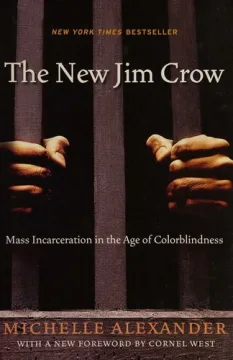
The New Jim Crow

By Michelle Alexander

Mass Incarceration in the Age of Colorblindness

Michelle Alexander argues that the extraordinary expansion of the United States criminal legal system—especially through the War on Drugs—created a durable structure of racial control after the formal dismantling of Jim Crow segregation. Her argument is not simply that individual officials may be prejudiced or that racial disparities are unfortunate side effects. She maintains that ostensibly race-neutral laws, discretionary policing, prosecutorial power, plea bargaining, sentencing policy, and the continuing penalties attached to a criminal record operate together as a system. The book begins by placing mass incarceration within a longer history of racial hierarchy, moving from slavery through Reconstruction, Jim Crow, and the late-twentieth-century politics of crime. It then explains how drug enforcement and criminal procedure give police and prosecutors broad discretion while courts make proof of systemic racial discrimination exceptionally difficult. Alexander follows people beyon…

View The New Jim Crow

The Color of Law book cover

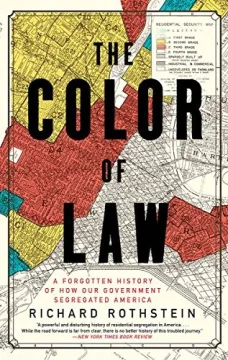
The Color of Law

By Richard Rothstein

A Forgotten History of How Our Government Segregated America

The book presents a historical and constitutional argument about residential segregation in the United States. Richard Rothstein disputes the familiar description of metropolitan segregation as merely de facto—that is, arising through private prejudice, household preference, economic inequality, or market behavior without decisive government involvement. He argues that federal, state, and local authorities repeatedly imposed, reinforced, or protected racial separation, making much of the resulting geography de jure segregation. ([guides.loc.gov](https://guides.loc.gov/real-estate-industry-sources/residential/fair-housing?utm_source=openai)) Rothstein builds this case through connected examples rather than a single-city history. He examines racially explicit zoning, segregated public housing, discriminatory federal mortgage policy, suburban development restricted to white purchasers, tax and land-use decisions, official tolerance of violence against integrating families, and public act…

View The Color of Law

Invisible Women book cover

Invisible Women

By Caroline Criado Perez

Data Bias in a World Designed for Men

Invisible Women examines what happens when institutions treat male bodies, routines, and experiences as the human norm. Caroline Criado Perez calls attention to a “gender data gap”: missing, unreported, or insufficiently separated information about women. Her central argument is not merely that women are absent from datasets. It is that decisions made from incomplete evidence can turn that absence into material disadvantages—including unsuitable products, ineffective public services, distorted economic measurements, and avoidable health and safety risks. The book moves from ordinary environments to increasingly consequential systems. Its six parts address daily life, employment, design, medicine, public life, and disasters. Examples involving transportation, toilets, unpaid care, workplace practices, protective equipment, phones, medical research, government spending, refugee assistance, and disaster recovery allow the same underlying pattern to be observed across otherwise unrelated…

View Invisible Women

The Jakarta Method book cover

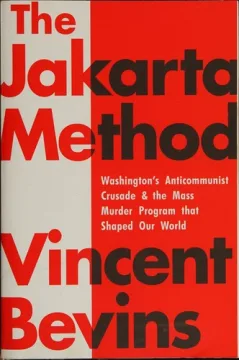
The Jakarta Method

By Vincent Bevins

Washington's Anticommunist Crusade and the Mass Murder Program That Shaped Our World

Vincent Bevins presents a transnational history of Cold War anticommunist violence, placing the Indonesian mass killings of 1965–1966 at the center of a much larger story. Rather than treating Indonesia as a peripheral episode in a contest dominated by Washington and Moscow, he argues that the destruction of Indonesia’s organized left was a major geopolitical turning point. The book traces connections among decolonization, the Non-Aligned Movement, the 1964 Brazilian military coup, the Indonesian Army’s rise under Suharto, and later campaigns of repression in Latin America and elsewhere. The phrase “Jakarta Method” describes more than one operation or fixed doctrine. In the book, it becomes a framework for recognizing a recurring political pattern: communist, socialist, labor, peasant, or reform movements are portrayed as existential threats; military and conservative forces receive encouragement or assistance; targeted people are detained, disappeared, or killed; and the resulting po…

View The Jakarta Method

Say Nothing book cover

Say Nothing

By Patrick Radden Keefe

A True Story of Murder and Memory in Northern Ireland

Say Nothing is a work of investigative narrative nonfiction about the Troubles and their long aftermath in Northern Ireland. Its central case is the December 1972 abduction and killing of Jean McConville, a widowed mother of ten taken from her Belfast home. McConville’s disappearance gives the book a human-scale route into a much larger history of republican militancy, British security policy, sectarian division, clandestine intelligence, imprisonment, political negotiation, and unresolved grief. Rather than attempting a complete chronological history of the conflict, Keefe follows intersecting lives. These include members of the McConville family; republican activists Dolours and Marian Price; senior IRA figure Brendan Hughes; and Gerry Adams, whose alleged relationship to the IRA is treated as a major question in the narrative. The book also examines the Boston College oral-history undertaking commonly known as the Belfast Project. Interviews recorded for that archive promised parti…

View Say Nothing

Evicted book cover

Evicted

By Matthew Desmond

Poverty and Profit in the American City

Evicted examines how the loss of a home operates within the broader machinery of American poverty. Its principal setting is Milwaukee during and after the 2008 financial crisis, where Desmond follows eight low-income families—Black tenants on the city’s North Side and white tenants in a South Side mobile-home park—along with the landlords whose decisions shape their housing prospects. Rather than presenting poverty only through statistics or policy analysis, the book reconstructs daily life under severe rent burdens: searching for apartments, negotiating with landlords, appearing in housing court, losing possessions, moving between temporary homes, and trying to preserve work and family routines amid displacement. The narrative is based on embedded fieldwork supplemented by interviews, surveys, and analysis of eviction-court records. Desmond reports that he interviewed 250 tenants in eviction court, surveyed more than 1,000 Milwaukee renters, and analyzed hundreds of thousands of cour…

View Evicted

The Overstory book cover

The Overstory

By Richard Powers

The Overstory is a large-scale literary novel in which the lives of nine Americans become entangled with trees, forests, scientific discovery, and environmental resistance. Its opening movement presents several largely independent personal and family histories. Each history contains an encounter with a particular tree or species—a surviving American chestnut, a banyan, a mulberry, a maple, or the ancient forests of the Pacific Northwest—that changes how a character understands time, survival, or human responsibility. These separate narratives eventually converge around forest defense and then branch apart again as the consequences of activism reshape the characters' lives. The novel is divided into four parts—“Roots,” “Trunk,” “Crown,” and “Seeds”—so that its architecture follows an arboreal pattern. This is more than decorative organization. The early biographies establish the characters' origins; the central sections connect them through shared purposes and conflicts; and the conclu…

View The Overstory