WebToTell

Books

Discover published books from independent authors and publishers.

Explore the library

Find your next book

253 unique books found Books may appear in more than one category.

The Varieties of Religious Experience book cover

The Varieties of Religious Experience

By William James

A Study in Human Nature; Being the Gifford Lectures on Natural Religion Delivered at Edinburgh in 1901–1902

In The Varieties of Religious Experience, psychologist and philosopher William James examines religion through the reported experiences of individuals rather than through creeds, institutions, or proofs of doctrine. Drawing on autobiographies, conversion narratives, mystical testimony, devotional writings, and psychological case material, he compares contrasting forms of religious life: confident spiritual optimism, profound awareness of sin and suffering, sudden or gradual conversion, saintliness, prayer, and mysticism. James asks where such experiences come from, how they alter personality, and whether their consequences justify treating them as meaningful. He rejects both automatic religious belief and automatic medical dismissal, arguing that an experience should not be judged solely by its psychological or bodily origins. Its practical effects—what it enables a person to become and do—also matter. Published in 1902 from his Gifford Lectures, the book helped establish the psycholo…

View The Varieties of Religious Experience

How We Die book cover

How We Die

By Sherwin B. Nuland

Reflections on Life's Final Chapter

In How We Die, surgeon and medical educator Sherwin B. Nuland examines what happens to the human body during common forms of death. Moving through heart disease, aging, Alzheimer’s disease, violence, accidents, suicide, AIDS, and cancer, he combines physiological explanation with clinical observation and personal stories. His purpose is not to offer reassurance through euphemism, but to replace frightening uncertainty with a clearer understanding of dying as a biological process. The book also challenges idealized images of a peaceful, fully controlled death. Nuland argues that medicine’s power to prolong life can become harmful when treatment continues without a realistic appraisal of its burdens and prospects. The result is both an anatomy of bodily decline and a reflection on hope, dignity, physician responsibility, and the difficult choices faced by patients and families near the end of life.

View How We Die

The Lords of Easy Money book cover

The Lords of Easy Money

By Christopher Leonard

How the Federal Reserve Broke the American Economy

Christopher Leonard examines the Federal Reserve’s transformation after the 2008 financial crisis, concentrating on years of near-zero interest rates and large-scale asset purchases known as quantitative easing. He argues that policies designed to stabilize markets and stimulate recovery also encouraged debt, elevated financial-asset prices, strengthened the position of major investors, and made the economy increasingly dependent on continued monetary support. The narrative is anchored by Thomas Hoenig, president of the Federal Reserve Bank of Kansas City, whose repeated dissents in 2010 expressed concern about financial instability and the long-term consequences of exceptionally easy money. Leonard also follows Jerome Powell from private equity into central banking, using corporate finance and industrial employment to connect monetary policy with activity outside Washington and Wall Street. The result is investigative economic journalism that presents central banking as a consequenti…

View The Lords of Easy Money

The City of Brass book cover

The City of Brass

By S. A. Chakraborty

A Novel

In eighteenth-century Cairo, Nahri survives by selling false magic to wealthy clients, even though her unexplained healing ability is real. A ritual performed as part of a con unexpectedly summons Dara, a formidable djinn warrior who recognizes something in Nahri that she cannot explain. Their flight from Cairo carries her into a hidden supernatural world and eventually to Daevabad, a brass-walled city divided by dynastic conquest, religious loyalties, ethnic hierarchy, and memories of violence. There Nahri becomes entangled with the ruling Qahtani family, especially the principled but politically inexperienced Prince Alizayd. The novel combines an adventurous journey with court intrigue, gradually shifting its central question from whether magic exists to who controls the history and institutions of the magical world. As the opening volume of the Daevabad Trilogy, it establishes a conflict in which inherited identity can confer power while also trapping individuals inside struggles b…

View The City of Brass

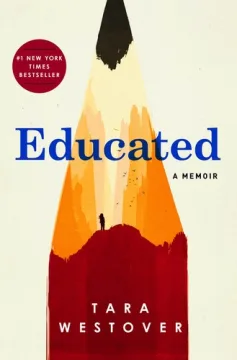
Educated book cover

Educated

By Tara Westover

A Memoir

Educated is Tara Westover’s memoir of growing up in an isolated survivalist family in rural Idaho and gradually building a life beyond the boundaries of her childhood. Without conventional schooling, she works in her father’s junkyard, absorbs a worldview shaped by religious certainty and distrust of public institutions, and initially lacks basic knowledge that her future classmates take for granted. Self-directed study eventually brings her to Brigham Young University and, later, to Cambridge and Harvard. Yet education does not function as a simple escape route. As Westover acquires language for history, power, violence, and personal autonomy, she must reconsider memories and loyalties that formed her identity. The memoir’s central conflict is therefore not ignorance versus knowledge alone, but belonging versus self-definition. It examines what happens when intellectual growth makes a former understanding of home impossible to sustain—and when telling one’s own story carries the risk…

View Educated

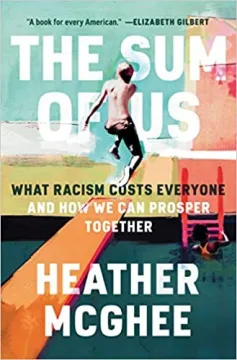
The Sum of Us book cover

The Sum of Us

By Heather McGhee

What Racism Costs Everyone and How We Can Prosper Together

Heather McGhee examines a central contradiction in American public life: policies shaped by racial division often harm the people they are presented as protecting. Drawing on economic research, political history, interviews, and reporting across the United States, she connects racism to weakened public services, barriers to healthcare, declining worker power, housing inequality, environmental danger, and restrictions on democratic participation. Her governing idea is the “zero-sum” story—the belief that progress for people of color must mean loss for white people. The book’s defining image is the public swimming pool that officials chose to close rather than integrate, sacrificing a shared resource to preserve racial exclusion. Against that pattern, McGhee develops the “Solidarity Dividend”: the material and civic gains made possible when people organize across racial lines. The result is both a diagnosis of American inequality and an argument that racial justice and broadly shared pr…

View The Sum of Us

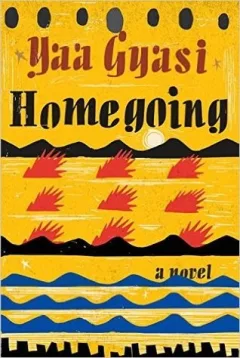
Homegoing book cover

Homegoing

By Yaa Gyasi

Beginning in eighteenth-century Ghana, Homegoing follows two branches of one family whose histories divide before its members know they are related. Effia becomes the wife of a British officer at Cape Coast Castle, while her half sister, Esi, is imprisoned below and transported into American slavery. Yaa Gyasi then moves through successive generations in alternating chapters, tracing lives shaped by the slave trade, British colonial power, racial slavery in the United States, convict leasing, migration, segregation, and their modern consequences. Each character receives a concentrated story, yet together those stories form a family saga spanning roughly 250 years. The novel’s central achievement is to make historical inheritance visible without reducing descendants to symbols of suffering. Love, ambition, complicity, estrangement, and survival remain intensely personal even as institutions limit what each person can choose. Homegoing presents history not as a finished past but as a fo…

View Homegoing

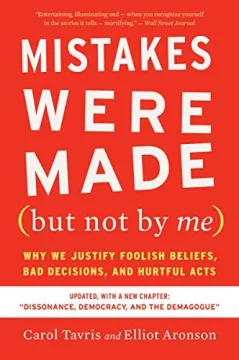
Mistakes Were Made (But Not by Me) book cover

Mistakes Were Made (But Not by Me)

By Carol Tavris , Elliot Aronson

Why We Justify Foolish Beliefs, Bad Decisions, and Hurtful Acts

Why do intelligent, decent people defend poor decisions long after the evidence has turned against them? Carol Tavris and Elliot Aronson answer through cognitive dissonance: the discomfort produced when facts or actions collide with a favorable view of oneself. Rather than revise that self-image, people often reinterpret evidence, alter memories, blame others, or intensify their original commitment. The authors trace this machinery of self-justification from private quarrels to professional judgment, criminal investigations, political allegiance, prejudice, and international conflict. Their central warning is not merely that people deceive others, but that sincere self-deception can make error remarkably durable. At the same time, the book argues that defensiveness is not destiny. By separating wrongdoing from a total condemnation of the self, individuals and institutions can become more capable of correcting errors, making meaningful apologies, and learning before a small mistake har…

View Mistakes Were Made (But Not by Me)

The Devotion of Suspect X book cover

The Devotion of Suspect X

By Keigo Higashino , Alexander O. Smith

A Detective Galileo Novel

Keigo Higashino’s The Devotion of Suspect X begins by revealing both a killing and the person who offers to conceal it. Yasuko Hanaoka and her daughter, Misato, kill Yasuko’s abusive former husband during a violent confrontation. Their neighbor, the solitary mathematics teacher Tetsuya Ishigami, constructs an elaborate plan to protect them. The central mystery is therefore not who committed the original act, but whether the police—and physicist Manabu Yukawa—can discover how Ishigami has reshaped the evidence. As Yukawa recognizes the mind of his former university classmate behind the apparently unbreakable alibi, the investigation becomes a contest between two exceptional reasoners. Yet the novel’s deepest concern is emotional rather than technical: what devotion permits a person to sacrifice, whether protection can become another form of control, and why a logically perfect plan may fail when confronted by conscience, grief, and human unpredictability.

View The Devotion of Suspect X

The Night Watchman book cover

The Night Watchman

By Louise Erdrich

A Novel

In 1953, Thomas Wazhashk works nights at a jewel-bearing factory near North Dakota’s Turtle Mountain Reservation while serving as a tribal council leader. When Congress promotes a policy presented as Native “emancipation,” Thomas recognizes its real danger: ending federal obligations, weakening tribal sovereignty, and exposing his community’s remaining land and institutions to dissolution. He begins organizing a resistance that must carry local testimony all the way to Washington, D.C. Alongside this political struggle, young factory worker Patrice Paranteau travels to Minneapolis in search of her missing sister, Vera, encountering an urban world of danger, exploitation, and uneasy possibility. Through these intersecting stories, Louise Erdrich portrays a community defending itself through paperwork, memory, humor, kinship, labor, and spiritual endurance. Inspired by the life and letters of Erdrich’s grandfather, Patrick Gourneau, the novel transforms an often-overlooked chapter of fe…

View The Night Watchman

The Years book cover

The Years

By Annie Ernaux , Alison L. Strayer

Spanning 1941 to 2006, The Years joins one woman’s life to the transformation of postwar France. Annie Ernaux recalls childhood, education, marriage, motherhood, work, sexuality, illness, aging, and the desire to write, but she resists presenting these experiences as a conventional first-person memoir. Instead, photographs, family meals, slogans, songs, advertisements, political events, consumer goods, and changing habits accumulate into the memory of a generation. The intimate and historical repeatedly alter one another: class mobility changes family language; reproductive freedom changes women’s futures; television and digital technology reshape attention; public events survive as fragments of ordinary conversation. By moving between “she,” “we,” and broader collective voices, Ernaux asks how much of a supposedly private identity is composed from shared social time. The result is both autobiography and social record—a sustained attempt to preserve lives, objects, expressions, and ex…

View The Years

The Facemaker book cover

The Facemaker

By Lindsey Fitzharris

A Visionary Surgeon's Battle to Mend the Disfigured Soldiers of World War I

The Facemaker recounts how surgeon Harold Gillies and an interdisciplinary medical team confronted the devastating facial wounds of the First World War. Modern artillery and trench combat produced injuries that existing surgical practice was poorly equipped to treat, leaving survivors with impaired breathing, eating, speech, and vision as well as severe social isolation. Lindsey Fitzharris follows Gillies from wartime service to his leadership of specialized treatment in Britain, where repeated operations, skin grafts, dental work, anesthesia, medical illustration, and careful experimentation helped establish modern reconstructive plastic surgery. The book is both a historical biography and a patient-centered account of medical innovation. It emphasizes that repairing a face was never solely a technical problem: the work also concerned identity, dignity, relationships, and the possibility of returning to public life. By placing surgical progress beside individual experiences of injury…

View The Facemaker